
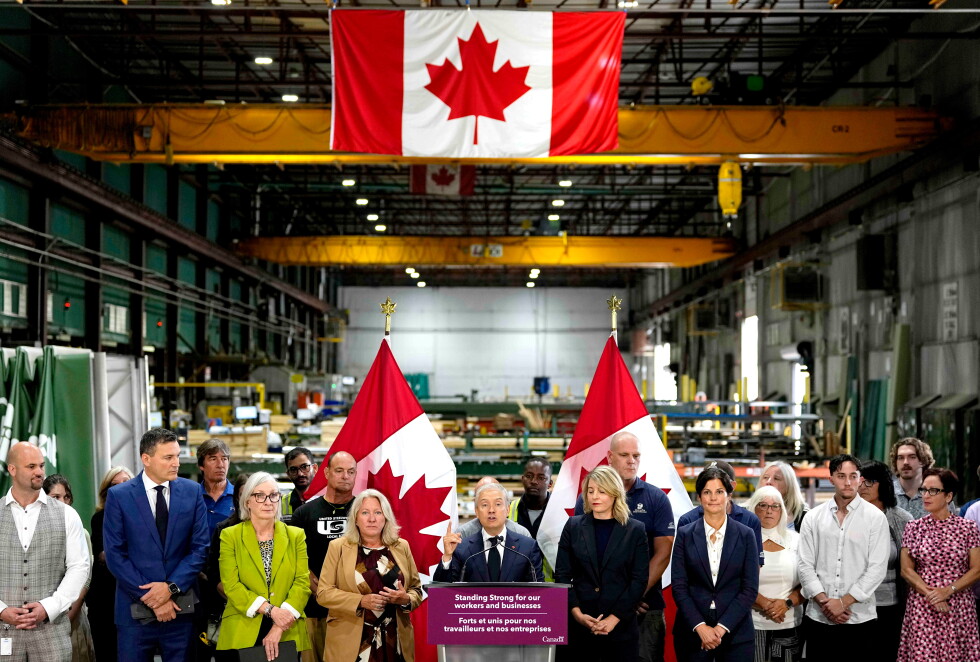
While Iran was being threatened by Donald Trump with economic D-Day, Canada was being threatened with a political D-Day. While a dispute over tariffs had appeared to be the cause of a breakdown in negotiations, Prime Minister Mark Carney suggested that something else was responsible. He contended that the US had raised the bar. “Last-minute changes in the US-proposed terms were unfair, uneconomic and called into question the reliability of any deal,” Carney said. He’s right. As I’ll point out later, the US negotiators introduced a host of demands unrelated to tariffs—demands that cut deeply into Canadian sovereignty.
The Tariff Issue
Jamieson Greer, the US trade representative, blamed Canada for walking away from a great deal. “New demands and walk backs of other commitments by Canada have upended the careful balance reached in the past days,” he said. Carney didn’t see things that way. He promised the US tariffs would be met “dollar for dollar,” Trump countered with 50 percent tariffs on Canadian autos, trucks, and steel, to begin January 1. Carney then authorized Canadian tariffs of 50 percent on US imports starting in September, though the tariffs will affect only about $20 billion of imports. That’s when Trump began using the occasion to escalate threats, saying “Canada has been ripping off the United States of America for years. Their ridiculously high tariffs on our Farmers and farm products has made life impossible for these great American Patriots,” Trump wrote in a post on his social media site. Canada is “among the worst Nations in the World to deal with.” But Carney may have the last word: “The attitude, at the negotiation table, that Canada is a subsidiary of the United States,” he said, “that’s not something we’re going to accept.”
The Real Deal
With the breakdown in talks came a raft of new charges from the Canadians about US demands that went far beyond tariffs. I’m relying here on reporting by Dean Blundell, a researcher for the Canadian political group Democracy, Inc., and by Matina Stevis-Gridneff and Ana Swanson (https://www.nytimes.com/2026/08/25/world/canada/trump-carney-trade-war-tariffs.html).
First, the US side apparently tried to dissuade the Canadians from shifting trade to other countries, notably China, and sought to dictate Canada’s steel tariffs on other countries. Carney said: “The U.S. introduced at the last hour, in the last hour, efforts to restrict our ability to have other trade deals.” He also said: “We are the partners of choice for countries around the world and the Americans wanted to restrict that — unacceptable.”
Second, and almost unbelievably, the US negotiators insisted that the French language not be used exclusively on Canadian products sold in Canada, including French films and online content. This cultural assault on bilingualism laws astounded the Canadians. Third, Carney said the US wanted to exempt Canadian-made auto and truck parts from tariffs if vehicles were assembled in Michigan, but not to exempt them if assembled in Ontario.
Fourth, US negotiators demanded an end to certain Canadian procurement practices, such as the “Buy Canadian” movement and the ban on US-made liquor. Fifth, the US side apparently made the strong suggestion that Canadian access to critical minerals, oil exports, the F-35 fighter jet, and Golden Dome missile defense would depend on Canadian tariff reductions on key US imports.
In the background of these US demands lay the USMCA free-trade agreement, which Trump has announced the US will not renew. His evident strategy in the negotiations with Canada was to pressure the Canadians into agreements that would lock them in when the USMCA is renegotiated. Here again, the Canadians would have none of it. They would not consent to blackmail.
Nationalism and Sovereignty
A Canadian writer, Stephen Marche, underscored the larger meaning of Canada’s saying no to the US (https://www.nytimes.com/2026/08/24/opinion/mark-carney-tariffs-canada-america.html). Canada had refused, he wrote, to bind itself “to a pseudodemocratic fiscal basket case of a nation whose only apparent foreign policy objective has become domination for the gratification of its president’s slapdash vanity.” Canada’s decision demonstrates the difference between Americans and Canadians: “For Americans, the capacity to project power, the ability to make things happen and to win are the primary virtues. For Canadians, the defining virtue is toughness, the capacity to endure.”
That same writer acknowledged that Canada will suffer some for defying Trump. But Carney’s insistence on protecting the country’s sovereignty is just. “The American president clearly did not know whom he was dealing with. He is following in the grand tradition of American leaders starting wars with people they don’t understand, then wondering what went wrong.” In a word, we Americans don’t understand others’ nationalism. And that is what is galvanizing Canadian resistance right now. As Carney told reporters in Ottawa: “Last spring, I warned that America is trying to break us so that they can own us. And I promised: ‘That will never, ever happen.’ We are keeping that promise” (https://www.nytimes.com/2026/08/22/world/canada/carney-trump-canada-tariffs.html).
The pettiness of the Trump administration’s conflict with Canada knows no bounds. Trump has renamed Lake Ontario Lake America. Vice President JD Vance, in a speech in Maine, referred to Canada as a state, then said that was an accident. Sure. But he continued: “Canada is a country that has underinvested in its military that quite literally would get invaded by a foreign country were it not for the umbrella of protection provided by the United States of America.” This boast may be just the thing that pushes Canada to impose export controls on products important to the US. Doug Ford, the influential premier of Ontario, has suggested just that: “He [Trump] underestimates Canada. We’re all in.up here, we’re at a fever pitch, everyone’s in for an economic war. They know they’re going to have to sacrifice.” Ford warned that key minerals and electricity to the US might be cut off. Alternatively, a tax on exports to the US might be enacted.
Both countries will suffer from this trade war. For the US, “We have been looking for relief on inflation,” said Claudia Sahm, chief economist at the investment management firm New Century Advisors, “and an escalating trade war with Canada puts that at risk and makes the affordability crisis worse.” Michigan is likely to be most affected, making its senatorial race all the more interesting. But in the end, as another observer notes, “The collapse of the talks is bad for both sides. This will be a body blow to North American competitiveness in this self-defeating trade saga. Americans will see their costs go up, and Canadians will see customers, investment and small businesses disappear.” Don’t tell Donald Trump that. He’s clearly fixated on statehood for Canada.


All this is all very strange. It makes you wonder why this distraction, at this time.
On the bright side, if Canada and the US were to merge, the new entity would become the largest country on the planet! Bragging rights, for sure. Would Canadians then be eligible to become president? That could solve all our problems.
cheers Tim
>
That’s the best, and only, argument for a merger. Carney for president!
This is one of your great ones. Can we include it? Is one of the charities about something you could stuff this into?
Jim
James R. Newcomer, Ph.D. Developmental and Line Editing NewcomerEdits.com jrnewcomer@protonmail.com (503) 351-9330
Sent from Proton Mail for iOS.