
Behind the rise in international conflict and the decline of peacemaking efforts discussed above lie weapons and the money that finances them. They provide the fuel for civil wars, wars of choice, and other forms of conflict. The world is awash with weapons, and the United States as always is leading the way. The latest figures are supplied by the Stockholm Peace Research Institute (SIPRI.org) in Sweden, the leading source for data on military spending and the arms trade. Here are some findings on the global arms situation along with my assessment of its larger implications.
Arms Transfers and Military Spending
In 2025, the US was by far the leading arms exporter at 42 percent of the world total. France is next at 10 percent, followed by Israel at 7.8 percent, South Korea at 6 percent, Russia at 5.8 percent, Italy at 5.7 percent, Germany at 5.1 percent, and China at 2.6 percent. The total value of US arms exports, nearly $14 billion, approximately equals the combined value for those next seven countries. Where are the weapons going? Mainly to the Middle East—for example, Saudi Arabia received 20 percent of US arms—and to NATO countries, starting with Poland (https://armstransfers.sipri.org/ArmsTransfer/CSVResult). Other examples of top arms customers: 19 percent of French arms were sent to Egypt, 62 percent of Russian arms to India, 48 percent of Italian arms to Indonesia, 28 percent of German arms to Ukraine, and 51 percent of Chinese arms to Pakistan,
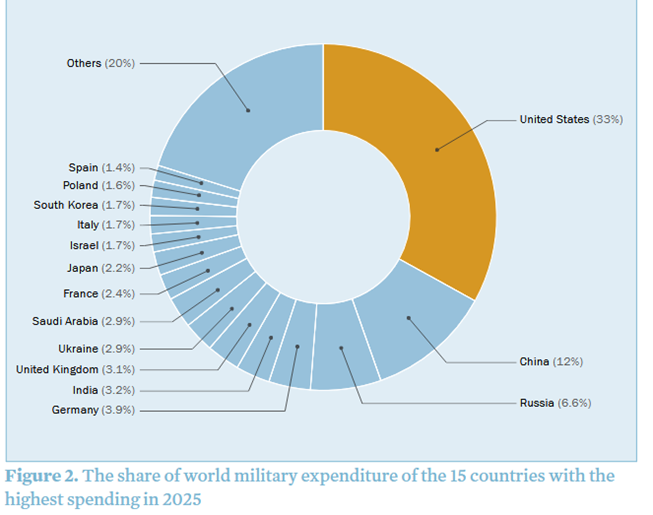
SIPRI reports that global military spending reached $2.887 trillion in 2025, the eleventh consecutive year of a rise, and an increase of 2.9 per cent in real terms over 2024. The top 15 spenders accounted for 80 percent of world military spending in 2025. The top five alone—the US, China, Russia, Germany and India—accounted for 58 per cent of the global total. The United States led the way with 33 percent of the world total. See the chart below.
Military spending figures can be tricky. They typically are well below actual spending on the military. Depending on the country, “military spending” might not include expenditures for nuclear weapons (in the US, those expenses come under the Department of Energy), weapons research and development, certain types of arms assistance, veterans’ affairs, and interest on the national debt because of wartime spending.
The figures concerning China are interesting. US military spending was 2.8 times China’s. But China is rapidly increasing military spending; it rose over 7 percent in 2025, driving increased military spending by others around Asia. And China’s increased spending occurred despite purges in the People’s Liberation Army (https://www.sipri.org/media/press-release/2026/global-military-spending-rise-continues-european-and-asian-expenditures-surge).
Bottom line: Everyone is spending more on arms either in preparation for conflict or to help others prepare for conflict.
The global military burden—that is, military spending as a percentage of GDP—rose to 2.5 percent in 2025. “On average,” SIPRI reports, “states in the Middle East had the highest military burden in 2025, at 3.8 per cent of GDP, followed by states in Europe (3.2 per cent), Africa (1.8 per cent), Asia and Oceania (1.6 per cent) and the Americas (1.2 per cent).”
Some Implications
First, the US remains by far the principal military power in world affairs. Its military spending and exports continue to be very high, increasingly driven by China’s activities but also by wars in Ukraine and Iran. The political power of MAGIC–the military-academic-governmental-industrial-complex–is a constant factor, particularly in today’s quasi-Cold War environment. The intersecting interests of the Pentagon, national security think tanks, relevant congressional committees and advisory groups, and the arms makers ensure that debate over weapons will always result in high military budgets and arms sales, no matter whether in peacetime or wartime. High military spending is one of the few issues that bring Republicans and Democrats together, as witness the bipartisan consensus in 2026 on a military budget in excess of $1 trillion.
Second, US arms sale and transfers to the Middle East, Russian and Chinese arms to rivals in the Indian subcontinent, and various arms suppliers that export to countries under authoritarian rule—all these stoke violence while promoting profits.
Third, while some US political leaders still refer to the country as the arsenal of democracy, the reality is that we’re an arsenal, period, at home as much as abroad. With more guns in Americans’ hands than there are people (roughly 400 million privately owned, with 11 million manufactured in 2020 alone); with mass shootings taking more lives every year, far more than in any other country); and with murderous attacks on schools that politicians can’t or won’t stop, we are a country out of control. Demand for guns has surged since the Trump years, and gun manufacturers’ profits are at an all-time high. The parallels between US arms policy abroad and its domestic counterpart are inescapable: the powerful combined influence of Congressional support for an unregulated gun market, the obeisance of right-wing politicians to the National Rifle Association and pro-gun lobbyists, and the impunity of gun manufacturers when mass shootings occur.


Dear All:
Mel knows full well my involvement in the war in Viet Nam. What he does not know is my (albeit tentative and, in my case, insignificant) response to that war and in wars in general.
I am a member of Veterans For Peace; chap. 159. More importantly, I went to Viet Nam, first in 1989, as part of the Veterans Viet Nam restoration Project, to build a medical clinic in Vung Tau. I was there for two months. There was, to me, a surprising sense of “the past is past; let us build our relationship anew.” Or words to that effect.
As you may recall, the relations between the Viet Namese and the U.S. were frosty. We were there with Cuba on the U.S. shit list. To put it more personally, we weren’t allowed the use of international mailing systems, and had our mail trucked in by a friend in Thailand.
The second time (and as a member of VVRP), I figured I was in the first mission, I (or rather we (including my wife), we had to be members of the last mission; mission number 29 (members of VVRP were getting a bit long in fang, so to speak;) and VVRP was disbanding.
That’s my story
Michael E. Peterson
Hi Mike, You’re right; I didn’t know this very important, and distinguished, part of your life. Sorry to learn the VVRP has disbanded, but your return to VN to help restore relations is worthy of great praise. Thanks for doing that; I’m sure folks at that clinic will long remember you and your comrades.
Dear Mel:
Thanks a lot! BTW, the second “tour” (in 2014), including my wife; was spent in Hue, when they were just finishing up the Citadel, whom the Americans and the Vietnamese largely destroyed in their attempts to dislodge the NVA. It is also the old “harbor site” of my duty with the Combined Action Platoons; between Hue and Phu Bai.
Unfortunately, that medical clinic was, over time, discontinued; and the site, as I know it, was put to further use.
Mike