
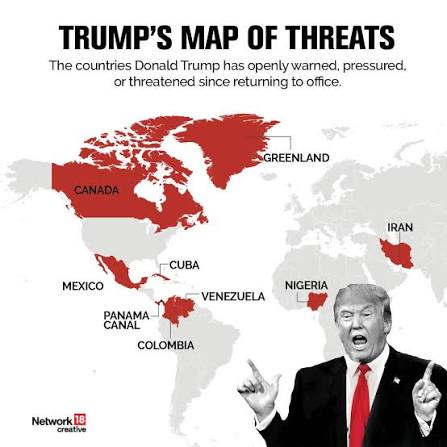
As global crises descend around him, Donald Trump seems increasingly incapable of a rational response. He rants and rails, threatens and indulges in delusions—and then retreats to one or the other of his vanity projects. This is not a president in control of himself or his position. And it’s costly. Here are the latest examples.
Economic D-Day?
Clearly frustrated and angry over the box he is in on the Iran war, Trump has lately moved between claiming that the Strait of Hormuz will be a “US territory” and threatening to “bomb the shit” out of poor little Oman, nominally a US ally. Then he declared “Economic D-day” with Iran in the following post on his social media August 19:
No one has given the Islamic Republic of Iran a greater opportunity to make a Deal than me. TRAGICALLY, for them, they have failed to take it. Therefore, today, I am announcing the MOST CRUSHING ECONOMIC OPERATION EVER TAKEN AGAINST ANY COUNTRY! This will be Economic Warfare and Isolation on an unprecedented scale. Their navy is gone, their air force is destroyed, their military factories are now rubble, their currency is worthless, and their country is hanging by a thread.
Equally worrisome about this threat is that Trump extended it to allied countries that do any sort of business with Iran. The post said:
Today, I am also announcing that ANY country that allows its financial institutions, businesses, airports, or government entities to provide any type of lifeline to Iran will itself face TREMENDOUS Economic Consequences. Oil smuggling, swap lines, cash transfers, exchange houses, ship registries, front companies — It all needs to stop NOW. You know who you are. This will be an ECONOMIC D-DAY, and we need all of our Allies to stand with the United States of America to isolate, and defeat, the Iran threat.
You cannot find such an outlandish, self-defeating threat anywhere in the files of US presidents. I haven’t counted the number of countries that fall into Trump’s very wide net, but it probably is quite a few. China comes first to mind; it’s not going to stop doing business with Iran, especially importing its oil, even if that means postponement of Xi Jinping’s forthcoming visit to Washington.
Undermining Alliances
Trump has also seemed to write off key allies in the Pacific. South Korea is the latest target. Not only has Trump leveled high tariffs on the Koreans; he has renewed a coziness with Kim Jong Un and degraded upcoming US-Korea joint military exercises without any prior consultation with South Korea. And he gave the most specious reason for that move: South Korea rejected Trump’s invitation to join in denuclearizing—not North Korea–but Iran! It’s hard to know if it is just stupidity here or being divorced from reality. Then again, Trump has never shown much respect for or assigned much value to security alliances.
Imagine how friends and foes alike treat Trump’s outbursts and erratic behavior. The Europeans have already decided they need to go their own way, starting with NATO’s support of Ukraine. Canada has rejected Trump’s trade proposals and promised to retaliate with high tariffs of its own. The Japanese, like the Koreans, have had to deal with Trumpian tariffs and pressure to invest billions of dollars in the US to offset them. But I suspect those promises will never be fulfilled; they’ll just wait for the next (Democratic) administration and a new, fair-minded deal.
But that’s the least of it. US allies are going to avoid Trump like the plague, trying their best to avoid his wrath but no longer placating him as they had been inclined to do. They will have to take a hard look at US security guarantees, which no longer are rock-solid. Can Japan, South Korea, and Taiwan still count on the US should China become more aggressive in the Taiwan Strait? Can the Europeans count on the US to support NATO’s collective security arrangement should Russia intrude into Poland or another member state? And for how much longer will the Saudis and the Emirates look to the US with assurance if the war with Iran returns to exchanges of fire?
Threats that Backfire
Beyond all these considerations lies an even more pointed criticism: The threats don’t work! Iran, for example, responded to Trump’s D-Day outburst by vowing “crushing, punishing and devastating” retaliation. Canada’s Prime Minister Mark Carney sent a strong, nationalistic message to the US, noting that “Canadians have met this moment with resolve . . .: vacationing in national parks, buying Canadian products, choosing Canadians. Small acts of solidarity, repeated millions of times that make a statement: We’re masters of our destiny.” And if Trump thought his accolades to Kim Jong Un would pressure South Korea, guess again. North Korea didn’t exactly jump at the chance for another Kim-Trump summit, showing that Trump once again gave up something—the joint military exercises—for nothing.
These questions point to why Trump’s daily barrage of threats and claims has real significance for national security. We have a president, and a secretary of defense for that matter, who simply cannot be trusted to say or do the right thing, and who can’t understand that diplomacy usually works much better than idle threats. They are undermining security, and US rivals don’t have to do anything to take advantage. They can just sit and wait as Trump deepens the holes he has dug.
 In the Human Interest - Mel Gurtov