
The Trap
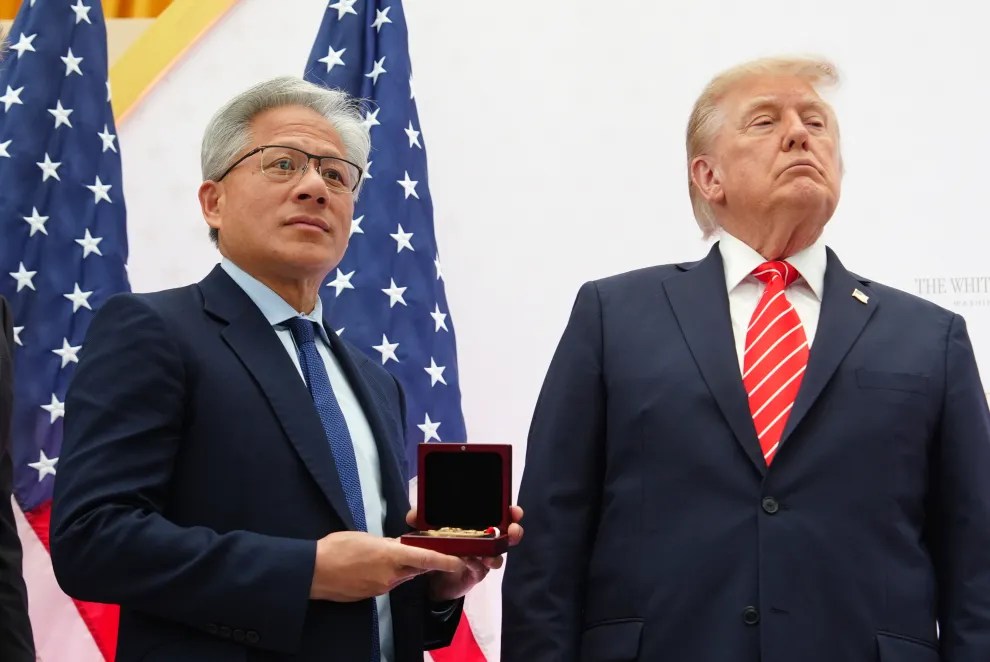
The Nvidia spy case at first seemed like a plot from a movie we’ve seen before. A wealthy executive falls into a “honey trap” and is extorted for large sums. The case involved a Chinese woman accused of spying for China while in a close relationship with Nvidia CEO Jensen Huang. US intelligence informed President Trump about the woman’s probable ties to the Chinese state security ministry last spring, just before he met with Xi Jinping in Beijing. Secretary of State Marco Rubio also warned Trump, saying that the woman was buying Nvidia’s most advanced chips for smuggling into China. Yet Trump took Huang, along with other US business people, to China. Huang is a well-known advocate for selling all but the most advanced chips to China. The woman in question has been a multibillion dollar purchaser of Nvidia’s and other companies’ products.
Once the story came out, Huang admitted to having a relationship with the woman, and Nvidia began its own investigation of Huang. Trump also deserved investigation, for three reasons. First, he ignored the warnings about Huang, saying they “didn’t make much of an impact on me.” Second, Trump defended Huang when the spy case came to light, calling him “a very honorable man” and saying he believed Huang when Huang told him he had no idea the woman was a spy. (Shades of Trump saying he believed Vladimir Putin more than he believed his own intelligence community on Russia election interference.) Third, Trump directly intervened with Nvidia’s board to urge Huang’s reinstatement. The board complied and dropped its investigation. “Trumpian socialism,” one critic called Trump’s action.
The Repercussions
The repercussions of this case range far and wide, impacting both US-China relations and Trump administration politics.
On the US-China front, Nvidia CEO Jensen Huang’s entrapment has further undermined relations that had appeared, following Trump-Xi summits in Korea and Washington, to have settled down. Don’t think the glitzy, hug-filled trilateral summit just held in Shenzhen, China reflected reality. The US-China competition over advanced AI chips is the prominent tip of a trade war that is far from normalized. The toppling of Huang and the spy charges are adding fuel to the fire. His reinstatement is unlikely to put the fire out.
Some Chinese commentaries suggest it will benefit China because while the US is preoccupied with reining AI in, China will be able to take advantage. But most other Chinese comments see Jensen Huang’s firing as evidence of anti-China bias on technology exports. And the Chinese are said to be incensed at the spying accusation. US intelligence claims both Huang’s female companion and her business partner were linked to China’s security ministry (as reported by the New York Times November 23). When a Bloomberg reporter tried to ask Xi Jinping about it at the trilateral summit in Shenzhen, she was booted out of the room. Comrade Xi doesn’t take questions.
On the home front, commerce department secretary Howard Lutnick is under fire from the treasury secretary, the Pentagon, and anti-China Congressmembers for failing to enforce the export control law, imposed in the Biden administration, that requires a foreign company to seek a license from the department to acquire advanced chips. Lutnick did not require that of Megaspeed, the company that exported the chips, valued at $7 billion, after China’s female spy bought them from Nvidia at Jensen Huang’s direction. What Lutnick should have done, critics say, is put Megaspeed on the US export ban list, which contains many companies that are suspected of being national security problems.
New Rules
In a press release November 16, the commerce department announced new rules restricting access to US technology via remote third-country data centers such as Singapore and Malaysia. It said the rules were “written at the direction of the Department of the Treasury and the National Security Council.” In other words, the rules change was imposed on Lutnick’s department. Yet Trump has defended Lutnick, saying: “If you didn’t delay it, if you did do something, you could have a blow up with China. We’re having a very good relationship with China right now.” Lutnick traveled to China with Trump last week, a sign he’s still in good graces. But if Trump worries about inflaming tensions with China, he should note China’s response to the new rules: a “textbook case of economic coercion and long-arm jurisdiction” that “disrupts the stability of global industrial and supply chains.” In a word, China sees the new rules in the same light as other US export controls—evidence (to employ Beijing’s official mantra) of “protectionism, unilateralism, and hegemony.”
Trump’s pressure on Nvidia’s board followed on calls from Silicon Valley executives and Elon Musk to demand Huang’s reinstatement. No surprise there. Trump had previously arranged for a US government stake in Nvidia’s chip sales to China and had given the go-ahead on a previous US export to China of less advanced chips. And the president is a stockholder in Nvidia. The Washington Post said Trump “reported trades this year that suggest he held between $13 million and $62 million in Nvidia stock as of the end of August [2026].” That was far more than he invested in earlier years, suggesting he benefited directly from Nvidia’s sales of supercomputer chips to China. The White House’s response? “Independent financial managers handle his portfolio.” They may “handle” his transactions, but they don’t make decisions about national security. Trump said he was assured by his intelligence officials that Huang’s retention would not harm US national security, but the reality is that Trump’s intervention was a national security decision—namely, that keeping Huang in charge of Nvidia was more important than any security concerns.
Some (Tentative) Conclusions
Here are a few conclusions we can reasonably draw from events so far:
First, Lutnick slow-walked export controls to improve his former firm’s (Cantor Fitzgerald) bottom line, since the firm has a significant financial stake in Nvidia.
Second, Trump rejected suspicions about Huang’s relations with a Chinese spy because Huang is a major donor and Trump has millions invested in Nvidia. Those ties trump Trump’s supposed concern about the AI competition with China.
Third, Huang at best is a naïve victim of a honey trap, next best is a security risk, and at worst is a Chinese asset. Perhaps interrogation of him at upcoming Congressional hearings will shed some light on that matter. In the meantime, this “great patriot and national treasure,” according to Trump, has made Wall Street and Nvidia stockholders like Trumk ecstatic.
Fourth, US export control laws on AI chips may now be tighter, but they won’t be enough to stop global trafficking or determine their end use. Chip smuggling, the New York Times points out, is now rampant worldwide. “Taiwanese customs data shows that from 2025 to 2026, over $60 billion worth of A.I. chips were most likely shipped to Singapore, Malaysia and Thailand, making these three relatively small countries among the largest importers of A.I. chips in the world.” Moreover, once those chips are either in China or obtained by renting a data center outside China that uses Nvidia chips, the chips can just as easily be used for military as for civilian purposes. And according to a Times report, these chips may be finding their way to military contractors linked to the People’s Liberation Army (https://www.nytimes.com/2026/11/20/us/politics/nvidia-alice-huang-chips-china.html).


Mel Gurtov raises an important question about the intersection of technological competition, national security, and political accountability.The deeper strategic issue, however, extends beyond the Nvidia case itself. Advanced AI chips are no longer merely commercial products; they are strategic assets with potential applications across civilian, industrial, intelligence, and military domains.Export controls may restrict direct transfers, but they cannot independently guarantee control over the global technology supply chain. Third-country data centres, intermediary companies, complex ownership structures, and the growing market for computing capacity create additional challenges for monitoring end use.There is also a fundamental tension between economic interests and national security priorities. When corporate influence, political relationships, and strategic decision-making overlap, the credibility of export-control regimes becomes a question of institutional integrity, not simply enforcement.Ultimately, the United States faces a broader challenge: how to preserve technological leadership without allowing commercial interests or geopolitical rivalry to undermine the very security framework it seeks to defend.The central lesson is that technological security requires more than restricting access. It requires accountability, international coordination, supply-chain transparency, and a coherent strategy linking economic policy with national security.Thank you, Professor Gurtov, for bringing these important issues into the discussion.Wahidullah Noorzai | NIDA
Thank you, Mr Noorzai, for such an excellent assessment that adds to my analysis.