
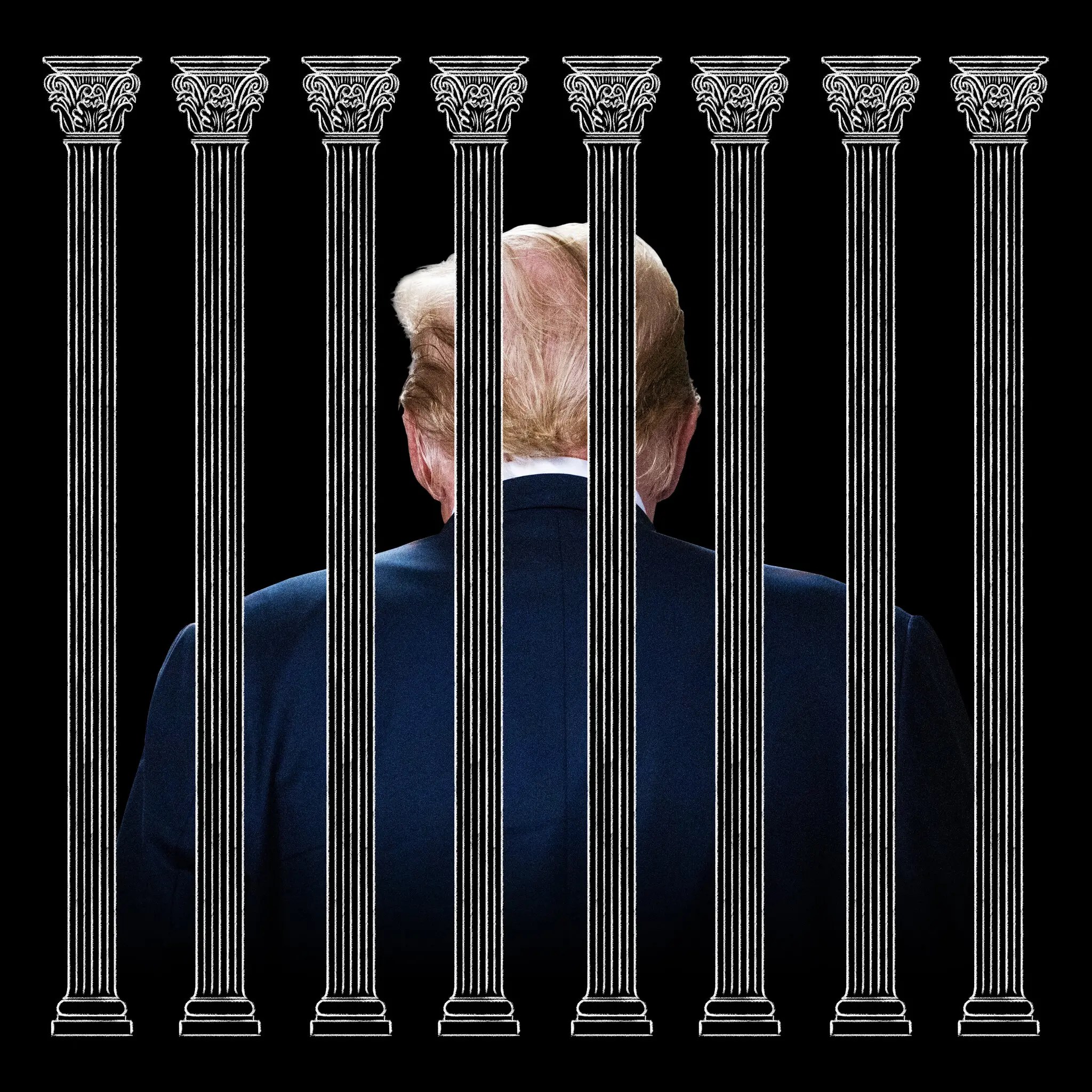
(Note to the Reader: This is the fourth iteration of a blog originally posted after the first two weeks of the Trump administration. It is intended as a catalogue in six parts of the outrageous policies, actions, and behaviors of Donald Trump and his lieutenants. I suggest that the inescapable conclusion from reading this collection is that only large-scale resistance can ensure our survival as a democratic community and enable our country to do good in the world.)
Donald Trump and his minions have managed to alienate, disrupt, disparage, and defy Americans and foreign friends alike. They have openly mocked Congress, the Constitution, the rule of law, and the virtues of diplomacy, all for self-serving ends. Their efforts come down to this: No foreign invasion could so systematically and quickly destroy the fabric of our society.
(1) Lawlessness
• Trump issued a clearly illegal and (according to a federal judge) “blatantly unconstitutional” executive order that disregards the 14th Amendment to the Constitution and is racist to boot: eliminating citizenship by birth in the case of babies born to parents in the US illegally. (Three appellate courts have now blocked the order, with one judge saying “no court in the country has ever endorsed the president’s interpretation.”)
• Trump’s transition team said the US will not grant asylum to people crossing the border illegally, in plain violation of international law that calls for granting asylum to people who have a reasonable fear of persecution. An appeals court ruled in April that Trump’s closure of the border with Mexico to asylum seekers on the grounds of an “invasion” was illegal. The administration’s response? Reject asylum applications for foreign nationals who answer “yes” to fearing “harm or mistreatment” if they return home–precisely the normal grounds for granting asylum.
• Trump’s declaration of a national emergency at the Mexico border is a political stunt; there is no emergency. Illegal border crossings are way down—“at levels below the final months of Trump’s first term,” the New York Times reports. Nevertheless, Trump’s tariff threats have forced Mexico to agree to deploy 10,000 troops to the border to keep migrants out of the US. The ACLU is suing Trump, arguing: “No president has the authority to override the [humanitarian] protections Congress has granted to people seeking safety at the border.” But Trump is using the emergency designation to deport tens of thousands of migrant workers and, where deportation or detention at Guantanamo is not feasible, house migrants in a network of military bases around the country—as many as 10,000 people at each base. Numerous reports cite inhumane conditions at these ICE facilities, in particular harming children separated from their parents.
• Under new guidance issued by the Trump administration, immigrants can now be denied a green card for expressing political opinions, such as participating in pro-Palestinian campus protests, posting criticism of Israel on social media and desecrating the American flag, according to internal Department of Homeland Security training materials reviewed by the New York Times.
• Trump said in his inaugural address that he wants to “expand our territory,” which translates to a new imperialism directed at Greenland, Canada, and at one time Panama. Never mind that the government and people there don’t want to be absorbed by the US. Trump has talked about taking “ownership” of the Gaza Strip, converting waterfront areas into another Riviera—with son-in-law Jared Kushner in charge. Even a postwar Iran has reportedly been the subject of US real estate investments.
• He has issued blanket pardons for over 1,500 January 6 insurrectionists, including many who committed violence that day and some who are dedicated to violence, such as the Proud Boys and Oath Keepers leaders. Overturning their convictions is meant to justify Trump’s incitement of them. • Trump promised to fire any civil servant who failed to report on a colleague who is acting in furtherance of diversity-equity-inclusion.
• Trump fired seventeen inspectors general in federal agencies. But his email termination notices may have violated federal law, the 1974 Impoundment Control Act, which requires Congress to receive 30 days’ notice of any intent to fire a Senate-confirmed inspector general. Trump intends to replace these watchdog appointees with loyalists, essentially ending the independence that is at the heart of the inspector general position. His press secretary said: “He is the executive of the executive branch, and therefore he has the power to fire anyone within the executive branch that he wishes to.” That claim in essence is the unitary executive theory favored by many Republicans.
• The administration violated the impoundment act with several other executive orders that imposed freezes on Congressional allocations, including the transportation department’s suspension of the Biden administration’s $5-billion allocation for new EV charging stations, grants to charities, and foreign aid. A federal judge on Marh 5, 2025 ruled that such freezes “fundamentally undermines the distinct constitutional roles of each branch of our government.” The judge directed the administration to cease impeding appropriated funds, but noted that his order had not been carried out.
• In furtherance of that presumed executive power, Trump ordered that independent regulatory agencies such as the Securities and Exchange Commission and the Federal Trade Commission be accountable to the White House for their budgets and policy priorities. The order challenges Congress’s role in establishing those agencies.
• A federal judge ruled on March 1, 2025 that Trump cannot remove the head of an independent watchdog agency without cause—in this case, the head of the Office of Special Counsel, which investigates whistleblower reports and protects federal workers from retaliation. The ruling came after a lawsuit by that official.
• The Trump regime is carrying out a purge of anyone in government service who had anything to do with prosecution of Trump’s many crimes. A purge—something we normally associate only with authoritarian systems—extends to the FBI, federal prosecutors, and the justice department’s several offices.. In the FBI, an apparently unwilling temporary director issued notifications to career field office leaders that they had been terminated. These orders were patently illegal; the officers are protected by civil service laws, and by law can only be fired if they commit crimes or engage in unethical conduct. (Nine FBI agents filed suit to prevent the Trump administration from collecting information on the agents in investigations of Trump. A judge ordered that the names of the FBI officials involved in the January 6 committee investigations be kept secret.) The purge also included the firing of over a dozen federal prosecutors in the US attorney’s office in Washington, as well as in other districts. Firings and transfers of career officials in the Department of Justice’s national security, civil rights, immigration, pardons, and public integrity divisions have gutted their leaderships and continuity.
DOGE
• Elon Musk announced his intention to “recklessly freeze streams of federal funding without warning.” He and his Department of Government Efficiency (DOGE) assistants—kids barely out of their teens, and without security clearances—followed through, seizing control of a little known but highly important treasury department office that distributes all federal payments—as much as $5 trillion at any given time. They gained access to huge personal data bases with the consent of Trump’s treasury secretary, Scott Bessent. It was called the biggest security breach in US history. A draft report by a subcontractor for Booz Allen Hamilton said that DOGE’s access to the Treasury’s payment system posed an “unprecedented insider threat risk” and should be suspended. Instead, Booz Allen suspended the subcontractor and said his report was unauthorized and would be revised.
• What exactly was Elon Musk’s status in the government? A White House staffer finally answered in mid-February, saying Musk was a senior adviser to the President, not an employee of DOGE. He had no decision-making authority; he was merely “overseeing” DOGE. So why did Musk attend cabinet meetings? Designating Musk an adviser was probably intended to put him out of harm’s way in lawsuits against the administration. But on March 14, 2025, a federal judge, in response to a lawsuit by fourteen Democratic state attorneys general, ordered DOGE to provide documentary evidence concerning its role in mass firings and the dismantling of government agencies. It’s the first time DOGE was directed to reveal the authority under which it was acting.
• Elon Musk’s search for ways to save the government money didn’t include his two biggest federal benefactors: the defense department and NASA. Together, those agencies account for over $26 billion in contracts for SpaceX and Tesla. Overall, this supposedly self-made man has received at least $38 billion in government support for his companies (New York Times editorial board, March 8, 2025) The conflicts of interest are glaring, but Trump’s justice department terminated all pending investigations of Musk and Tesla.
• Washington Post and New York Times investigations of Musk’s claims of billions of dollars in savings for the government found the claims to be largely spurious. Many canceled government contracts had already been carried out, yet were counted as though ongoing. The Times reported that the DOGE’s math was “marred with accounting errors, incorrect assumptions, outdated data and other mistakes . . . While the DOGE team has surely cut some number of billions of dollars, its slapdash accounting adds to a pattern of recklessness by the group.
• In response to a lawsuit by nineteen state attorneys general, a federal judge ordered a halt to the DOGE operation in the treasury department and the destruction of “any and all copies of material downloaded from the Treasury Department’s records and systems” since January 20, 2025. A temporary restraining order was placed on DOGE to block it from accessing taxpayer records. Trump and Bessent were ordered to appear in court to defend their actions. But Trump’s lawyers challenged the judge’s decision, saying he had no right to interfere with a president’s power to order DOGE’s activities. The same federal judge agreed, at least temporarily.
• DOGE members accessed data at the Department of Commerce’s NOAA section, the Department of Transportation’s Federal Aviation Administration, and the Department of Education’s federal student loan data, according to an ABC News report. Most ominously, DOGE personnel were given access to the highly restricted Integrated Data Retrieval System of the IRS—data (such as taxpayer IDs and bank information) for every taxpayer and business in the US. The new IRS commissioner had yet to be confirmed by the Senate when DOGE received permission to access the files.
• DOGE also bullied its way into the Social Security offices, seizing data on taxpayers without explanation in what the Washington Post said “amounted to a de facto coup.” The agency’s former chief of staff, who was forced to resign, filed a federal lawsuit, saying that the DOGE invasion “could result in benefits not being paid out or delays in payments. … The stakes are high.”
• A federal judge ruled in May 2026 that DOGE did not have the authority to cancel National Endowment for the Humanities grants, which amounted to more than $100 million in congressionally appropriated funds. DOGE used ChatGPT to decide which grants would promote diversity, equity and inclusion, or DEI, but did not tell the AI chatbot how it defined the term.
• DOGE representatives fired specialists at the National Nuclear Security Administration, the agency within the Department of Energy that is responsible for the country’s nuclear weapons stockpile. Then, upon realizing the stupidity of what they had done, and insisting they had only fired clerical staff, DOGE began looking for the fired personnel to invite them back to work. They’re still looking.
• DOGE officials gained access to payment and contracting systems across the Department of Health and Human Services. The department controls hundreds of billions of dollars in annual payments to health-care providers, and they appear to have gained access to at least some of those systems. • DOGE personnel gained access to computer systems of the Consumer Financial Protection Bureau, which Trump has tried to abolish. But the CFPB has managed to stay alive, thanks to judicial order. Pending is a judge’s decision on whether or not the administration has the right to dismantle the agency altogether.
• The Trump administration took aim at sanctuary cities—those that refused to cooperate with ICE efforts to nab illegal immigrants—by threatening to cut off federal aid and prosecute city officials. Several cities, including San Francisco and Portland, filed suit to block the administration. The San Francisco city attorney argued: “This is the federal government illegally asserting a right it does not have, telling cities how to use their resources, and commandeering local law enforcement. This is the federal government coercing local officials to bend to their will or face defunding or prosecution. That is illegal and authoritarian.”
• Trump issued an executive order to deny gender-affirming treatment for trans children, part of a war for “biological truth.”
• On the public health front: administration of the key public health agencies was in the hands of medical quacks (Dr. Mehmet Oz to head the Centers for Medicare and Medicaid Services; Dr. Jay Bhattacharya, to head the National Institutes of Health) and unfit pretenders (RFK, Jr.). Kennedy purged the many medical advisory groups of supporters of vaccines. Food security at the FDA was under a hunting buddy of Donald Trump, Jr.; the previous administrator, a scientist, resigned in protest. Research programs in several areas of public health were cut and their staffs forced to resign. The USAID’s provision of Ebola vaccines in Uganda was blocked, then restored, but not in time to make the life-saving program workable.
• Trump’s executive order to the Dept. of Homeland Security for an indefinite “pause” on refugee admissions to the United States was blocked by a federal judge, who said the order appeared to amount to a “nullification” of federal law and “has crossed the line from permissible discretionary action to effective nullification of congressional will.” The State Department, in response to Trump’s order, drafted a list of 43 countries whose citizens would be barred or restricted from entering the US. The only refugees being allowed into the US are white South Africans.
• Trump ordered the US Department of Agriculture to remove references to the climate crisis from its website; put the Environmental Protection Agency on the chopping block (more than 50 percent of its staff and budget were eliminated); blocked the Centers for Disease Control and Prevention from publishing scientific information on the threat of bird flu to humans; fired senior leaders at the Federal Emergency Management Agency (FEMA) and cut about 1,000 jobs, just as the hurricane season was approaching; fired around 800 people at the National Oceanic and Atmospheric Administration (NOAA), putting critical weather forecasting in a bind; and repealed the 2009 “endangerment finding,” which provides the basis for regulating greenhouse gases under the Clean Air Act.
• An executive order to close the Department of Education required Congressional approval, but gutting it did not. In March 2025, the administration fired half the DOE staff—1,300 people. Another 572 people accepted separation packages. The head of the National Education Association said when eliminating the DOE was first proposed: “If it became a reality, Trump’s power grab would steal resources for our most vulnerable students, explode class sizes, cut job training programs, make higher education more expensive and out of reach for middle class families, take away special education services for students with disabilities, and gut student civil rights protections.” The new DOE leadership indeed took aim at affirmative action. A letter in mid-February 2025 to all schools from the department’s Office for Civil Rights said that any consideration of race in any school decision (such as on admissions, hiring, and scholarships) would be considered unlawful and grounds for elimination of federal assistance. This demand went far beyond the Supreme Court’s decision against considering race in admissions policies.
• Trump appointed himself the “amazing” new chairman of the Kennedy Center for the Performing Arts, ordered that his name be added to the Center’s title and all its activities, and dismissed several board members “who do not share our Vision for a Golden Age in Arts and Culture”—this from a man who never visited the Center and hadn’t the slightest interest in arts and culture. Trump appointed two Fox anchors, Laura Ingraham and Maria Bartiromo, to the Kennedy board and named Richard Grenell, Trump’s envoy for overseas hot spots, to be executive director. Numerous artists cancelled performances in protest. Then, in May 2026, a federal judge ordered that Trump’s name be removed from the Center and rejected his plan to close it for repairs for two years.
• People at the FBI, Homeland Security, and other agencies who worked on foreign influence operations, such as election interference by Russia, China, and others, have been fired. As the New York Times reports, “Experts are alarmed that the cuts could leave the United States defenseless . . . and embolden foreign adversaries seeking to disrupt democratic governments.”
• Probably as prelude to privatizing the US Postal Service, Trump has taken away its independence and put it under Howard Lutnick’s commerce department.
• A federal judge on Feb.27, 2025 decided that the order for the mass firings of probationary government workers at several agencies be rescinded, as the American Federation of Government Employees had argued in court. “The office of Personnel Management does not have any authority whatsoever under any statute in the history of the universe to hire and fire employees at another agency,” said the judge. Only Congress has such authority. On March 12 and 13, two other federal judges rescinded the firings of probationary workers by the Office of Personnel Management at virtually all agencies and ordered that their jobs be immediately restored.
• Trump ordered a reduction of $400 million in federal grants to Columbia University because of its “antisemitic” policies. The order was followed up by two outrageous actions: a raid on Columbia’s student housing in search of two Palestinians who were leaders in student protests of Israeli policies in Gaza; and a demand that Columbia make wholesale changes in its disciplinary and admissions policies. One of the arrested students, Mahmoud Khalil, is a permanent resident with a green card, not a student visa; yet he was removed by ICE officers from New York and placed in a prison in Louisiana. (Khalil has successfully petitioned to avoid deportation.) The demand for policy changes holds Columbia hostage to the Trump administration, which can reverse or add to the federal grants already rescinded should it not be satisfied with Columbia’s response on “antisemitism.” The administration has already determined that certain regional studies programs, such as on Africa and South Asia, should be placed under “academic receivership.”
(2) ATTACKS ON FREEDOM OF THE PRESS
• Freedom of the press is being eroded daily. In the Pentagon, the main news outlets, such as the New York Times and NPR, have been removed from their usual office and replaced with Breitbart, One America News, and other right-wing supporters of Trump’s policies. His chair of the Federal Communications Commission has announced an investigation of financial sponsors of NPR and PBS, with the evident aim to scare them off and remove government support. But a district court in Washington, D.C. permanently blocked Trump’s executive order in May 2026 to stop federal funding of National Public Radio and the Public Broadcast Service, citing First Amendment protections against viewpoint discrimination.
• When the Iran war broke out, the administration took action against news organizations that reported unfavorably or raised impertinent questions about the war. It issued subpoenas to the Wall Street Journal, for instance, and ordered the justice department to investigate ABC News. Brendan Carr, Federal Communications Commission head, threatened to take away the broadcast licenses of companies that didn’t “correct course.” “Broadcasters must operate in the public interest, and they will lose their licenses if they do not,” he said. But this latest cycle of pressure on the media is being resisted, unlike earlier in the administration when the media largely kowtowed.
• Trump and Musk initiated a campaign of harassment of news organizations, suing (under the guise of consumer protection) to rein in their independent reporting. CBS (Paramount) and ABC have paid off Trump rather than contest his ridiculous charges of programming bias. Lara Trump will have her own Fox News show, further ensuring Fox conformity with the party line. (As she said: “I certainly hope they can take me being on the team at Fox as a very clear indication as to where Fox stands.”) The Associated Press was blocked from access to Trump’s news conferences and other venues until it accepted that the Gulf of Mexico is now the Gulf of America. (AP sued on First Amendment grounds, but a judge upheld Trump’s decision.) And in a break with longstanding tradition, Trump’s press secretary announced that the President, and not the press pool, will choose which reporters may ask questions at his press conferences, on flights, and on other occasions. The White House Correspondents Club issued a withering criticism of this decision. The Voice of America has been dismantled by executive order, putting Trump loyalist Kari Lake out of a job. According to the New York Times,VOA journalists had been under investigation “for reporting on criticism of Mr. Trump or for making comments that were perceived as critical of him.” Over 3,000 of them and other VOA workers were forced out, ending access to over 400 million people in 63 languages and over 100 countries.
• Bowing to Trump, Washington Post owner and billionaire Jeff Bezos took over the editorial page, saying that from now on, only one view will prevail when it comes to personal liberties and free markets. The editorial page editor resigned in protest, understanding full well that “one view” means the Trump administration’s view. Dana Milbank was not fooled either. In an opinion piece, he courageously wrote: “this much is clear: If we as a newspaper, and we as a country, are to defend his twin pillars, then we must redouble our fight against the single greatest threat to ‘personal liberties and free markets’ in the United States today: President Donald Trump.” Ruth Marcus, a fixture on the opinion pages, resigned after an article critical of Trump was rejected for publication.
• When the Iran war broke out, the administration took action against news organizations that reported unfavorably or raised impertinent questions about the war. It issued subpoenas to the Wall Street Journal, for instance, and ordered the justice department to investigate ABC News. Brendan Carr, Federal Communications Commission head, threatened to take away the broadcast licenses of companies that didn’t “correct course.” “Broadcasters must operate in the public interest, and they will lose their licenses if they do not,” he said. But this latest cycle of pressure on the media is being resisted, unlike earlier in the administration when the media largely kowtowed.
(3) CORRUPTION
The Crypto Currency Scandal
• Trump created a working group in support of cryptocurrency (“digital assets”), in a blatant example of conflict of interest. Trump and family have a substantial personal investment in the crypto industry, having started a crypto company called World Liberty Financial. Trump and Melania are shlocking their own coins along with the shoes, perfume, Bibles, and hundreds of other goods bearing the Trump logo. The $Trump memecoin has shocked the crypto industry, one of whose members and Trump supporter said Trump’s marketing makes cryptocurrency “look corrupt and self-interested.” Oh, really?
• Howard Lutnick, chairman and CEO of the Wall Street investment bank Cantor Fitzgerald and Donald Trump’s secretary of commerce, has his hands deep into the cryptocurrency netherworld. Cantor Fitzgerald is a banker for Tether, a stablecoin that is the most-traded cryptocurrency in the world. Of concern to many is the use of stablecoin in secondary markets to finance terrorism, facilitate cybercrime, money laundering and the sale of precursor chemicals for illicit drug manufacturing. As commerce secretary, Lutnick is responsible for regulating stablecoin business. Notably, Tether announced plans to move its headquarters to El Salvador, whose authoritarian leader, Nayir Bukele, has embraced cryptocurrency as a competitive advantage, moving its own economy and currency into crypto. Bukele was the second leader, after Saudi Arabia’s Mohamed bin Salman, to be called by Trump after Trump’s inauguration. Marco Rubio visited Bukele, and they reached an agreement whereby El Salvador would receive not only Salvadoran deportees, but any criminals in the US—for a fee, of course.
• Argentina’s pro-Trump president, Javier Milei, has gotten into the act. On Valentine’s Day 2025, he touted a new cryptocurrency, $Libra, and people gobbled it up. The Times describes what happened next: “$Libra’s value skyrocketed. Then it swiftly collapsed. The largest stakeholders had sold their coins, leaving almost everyone else with a collective $250 million in losses.” This is exactly what happened when Trump’s memecoin was announced. He and his family pocketed at least $100 million from the initial purchases. 800,000 other investors lost an estimated $2 billion when the insiders pulled out. Trump responded as he usually does when he’s caught in scandal: “I don’t know if it benefited” me, he said. “I don’t know much about it.” That’s exactly what Argentina’s president said: He knew nothing about it, the $Libra idea came from a Singapore outfit, he didn’t benefit at all. Milei might have paid a political price for his stupidity, but he won reelection, with Trump warning of economic punishment of Argentina if Milei fell short.
Conflicts of Interest and Other Scandalous Behavior
There are now so many cases of blatant conflicts of interest by Trump, his family members, and his cabinet and other officials that it is almost impossible to list them all. These conflicts include use of public office for personal gain (particularly real estate transactions while on diplomatic missions), hiring of companies that contribute to Trump’s war chest for federal projects without competitive bidding, and “pay to play” for presidential pardons. Following are just a few recent examples.
• The administration paid a construction firm far more money than was warranted on a no-bid contract to repair fountains in Washington’s Lafayette Park, across the street from the White House. The contract was not reported as required under federal law.
• A judge ruled that the Trump ballroom construction may only proceed with the basement based on Trump’s insistence that the $400 million ballroom is a national security concern.
• After failing to pass judicial review of a $10 billion demand from his own administration to pay for IRS release of his tax information, Trump convinced the justice department to pay him $1.7 billion in what amounts to a slush fund to “reimburse” people whom he determines have been wronged by the government. That would include rioters who stormed the Capitol on Jan. 6, 2021. The IRS reportedly had prepared a defense against Trump’s suit but dropped it. But a federal judge reopened the deal in May 2026, saying it reeked of “deception” by the administration. She said she was “empowered to investigate serious misconduct” in any case before her and ordered Trump’s lawyers to tell her by June 12 whether the lawsuit should be formally reopened because “the court was the victim of a fraud.”
• The justice department ruled that the tax returns of Trump and family and their businesses, and tax claims against them, will be “forever barred” from an audit. That unprecedented ruling is contrary to federal law, which excludes no one from an ongoing audit, and was signed off only by the acting attorney general despite the fact that the IRS is under the treasury department.
• A few months after Trump bought between $1-5 million of Dell Technologies stock and encouraged supporters at various events to buy Dell computers, the company’s stock soared and it was granted a $9.7 billion Pentagon contract. (The Dell foundation also pledged over $6 billion to help fund “Trump accounts” for needy children.)
(4) BUDGET CUTS AND HUMAN RIGHTS
• In a move consistent with his early “shock and awe” strategy, Trump and Secretary of State Marco Rubio announced that virtually all foreign aid—the $60-billion budget for humanitarian, development, and military—would be suspended pending a review. The only exceptions to the suspension were military aid to Israel and Egypt, and emergency humanitarian assistance. In March, Rubio announced that the review had been completed. The US Agency for International Development (USAID) would be administered by the state department and 83 percent of its programs would be terminated, including the enormously successful AIDS program that started under George W. Bush and is credited with saving more than 25 million lives worldwide.
• Other programs affected by the aid cuts are the US contribution to the World Health Organization and US aid to Vietnam, Cambodia, and Laos to find and clear unexploded ordnance (bombs, mines, ammunition) the US used during the Vietnam War. Responding to the budget cuts, two Democrats in Congress said: “As leaders of the House and Senate Committees on Appropriations, we write with extreme alarm about the administration’s efforts to undermine Congress’s power of the purse, threaten our national security and deny resources for states, localities, American families and businesses.”
• As for USAID employees, a federal judge ruled on February 21, 2025 that the administration was entitled to place thousands of them on leave. The judge relied on official assurances that AID program changes were being reviewed, and that the government had made a strong case that its actions “are essential to its policy goals.” But less than a week later, another judge ordered that the administration comply with an unfreezing of $2 billion in USAID funds that were under contract. The order had been issued twelve days earlier but ignored by the administration. The exasperated judge reiterated that the government “shall take no actions to impede the prompt payment of foreign assistance funds.” The Supreme Court has upheld that decision but has not provided a timeline for payments.
• Ukraine has suffered significantly from the decision on USAID. The State Department has cut off its support of Ukraine’s energy facilities, which have been subject to constant attack by Russia. USAID’s mission in Ukraine has been reduced from sixty-four to eight.
(5) THE ASSAULT ON THE PROFESSIONAL MILITARY
• Trump (in the words of the New York Times) “fired the first woman to ever lead a military service branch [Admiral Linda Fagan], signed an order to send [1500] active-duty U.S. troops to the border [in what one officer called a photo op] and said he was reinstating, with back pay, former service members who had refused to take Covid vaccinations, a breach of military health rules.”
• General Mark Milley, Joint Chiefs of Staff chairman under both Trump and Biden, was accused of disloyalty. Portraits of him at the Pentagon were taken down, his security detail was removed, and defense secretary Pete Hegseth promised to investigate Milley despite his having been pardoned by Biden. Milley, you’ll recall, refused to support Trump’s hope to use the military against Black protesters in 2020 and explicitly called Trump a fascist and national security threat more than once.
• Hegseth, who squeaked by in the confirmation vote, added to the military’s unease with comments about its current leaders. He called Admiral Lisa Franchetti, the chief of Naval Operations and the first woman to serve on the Joint Chiefs, “another inexperienced first.” Hegseth fired her. Actually, she had an exceptional combat record, as did the JCS chairman, Gen. Charles Q. Brown Jr., whom Trump fired for being too “woke.” Judge advocates general for three services were also fired. Hegseth also took the highly unusual step of blocking the promotion of four Army generals from a list of three dozen. Two of the blocked officers are Black, the other two female.
• Trump and Hegseth also went after an array of service personnel who (according to Trump’s executive order) were “afflicted with radical gender ideology to appease activists” and had “many mental and physical health conditions [that] are incompatible with active duty.” That meant soldiers with diagnoses “that require substantial medication or medical treatment to bipolar and related disorders, eating disorders, suicidality, and prior psychiatric hospitalization.” But the harshest targeting was directed at transgender soldiers, who were said to be living in conflict “with a soldier’s commitment to an honorable, truthful, and disciplined lifestyle, even in one’s personal life.”
• Six members of Congress, all Democrats, were investigated by Hegseth after they advised members of the armed forces in a video of their right under military law to refuse illegal orders. When that attempt failed, Hegseth said he would revoke the pension and rank of one of the Democrats, Senator Mark Kelly.
(6) TYRANNY AND THE RULE OF LAW
• We are in a constitutional crisis. Donald Trump has apparently convinced himself and everyone around him that he has a popular mandate to do what other dictators do, namely, rule by executive decree and expect no dissent. Doubt that? “He who saves his Country does not violate any Law,” Mr. Trump wrote, first on his social media platform Truth Social, and then on the website X. The sentence then appeared on the White House website. And the Supreme Court has already given him immunity for all his official acts. So we’re dealing with a wannabe dictator, pure and simple.
• The tyrant seeks revenge against anyone who has criticized, challenged, or defeated him, past or present. Donald Trump has a long enemies list, and he has a justice department willing to carry out his personal vendettas. Among those whom Trump has pursued are E. Jean Carroll, Jimmy Kimmel, Letitia James, Senator Adam Schiff, Jack Smith, George Soros, John Bolton, hundreds of FBI and other civil servants who worked on Trump’s convictions, the Fed’s Jerome Powell and Lisa Cook, James Comey, and various judges—all to underscore the point that Trump as president is all-powerful and demands obedience. Comeys recognized shortly after being named attorney general in Trump’s first term who he was dealing with. Like a Mafia chieftain, said Comey.
• The Washington Post points out that not a single one of Trump’s nominees was willing to say that s/he would refuse an illegal order from the President. Indeed, Trump is acting as though Congress and the judicial system are of little significance—that he can override or bypass any rules or norms he finds inconvenient. That includes the most fundamental power given to Congress by the Constitution: the ability to appropriate tax money and determine how it is spent. A torrent of legal challenges to Trump’s authoritarian rule is ongoing. (Stay abreast at https://www.justsecurity.org/107087/tracker-legal-challenges-trump-administration-actions/).
• The war on Iran that began Feb. 28, 2026 was launched without regard to Congress or the War Powers Act. Nor was the decision evidently taken with concern about international law, war aims, end date, or Iran’s capacity to retaliate. This illegal war has been a strategic blunder of enormous proportions, marked by escalating casualties, expansion of the war zone by Israel, rising oil prices, new opportunities for Russia and China to expand their influence, and the likelihood of an even more repressive and nuclear bomb-minded Iranian leadership than was true before the war. Every attempt in Congress to require authorization of the administration’s war policies in conformity with the WPA has been rejected.
• We knew this was coming: the Trump team would seek to defy judicial rulings against them. The particular ruling that halted Musk’s invasion of the treasury department’s data base prompted dangerous pushback from Vance, Musk, and Stephen Miller, the deputy White House chief of staff.
Vance: “Judges aren’t allowed to control the executive’s legitimate power.”
Musk: “A corrupt judge protecting corruption. He needs to be impeached NOW.”
Miller: “An assault on the very idea of democracy itself.”
Trump: “We’re very disappointed with the judges that would make such a ruling, but we have a long way to go. No judge should frankly be allowed to make that kind of a decision.”
In fact, all signs point to an administration that is determined not to be bound by judicial decisions. See https://www.theguardian.com/us-news/2026/may/02/judiciary-trump-administration-separation-of-powers.
 In the Human Interest - Mel Gurtov
Mel,
“No foreign invasion could so systematically and quickly destroy the fabric of our society” says it all.
This is perhaps your most powerful critique of the multi-year series.
But what’s next?
The critique is so overwhelming that the reader, many readers, may simply despair.
The next major article, or series of articles should move from Trump’s crimes to discussing possible strategies for ending the assault on American (and world) democracy and human rights that you’ve so well documented.
A much more challenging agenda perhaps.
mark
? Mark Selden http://www.markselden.net Founding Editor (2004-24), The Asia-Pacific Journal http://apjjf.orghttp://apjjf.org/ Dying for an iPhone: Apple, Foxconn and the Lives of China’s Workershttps://www.haymarketbooks.org/books/1468-dying-for-an-iphone. Haymarket Books 2020. Choice Academic Selection 2022. A Chinese Rebel Beyond the Great Wall: The Cultural Revolution and Ethnic Pogrom in Inner Mongolia. University of Chicago Press 2023.