
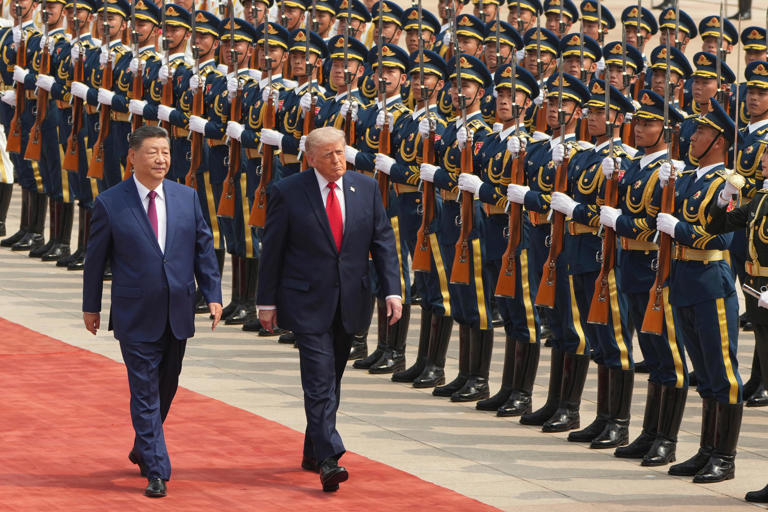
A Transformed Relationship
A study of five decades of US-China summitry by the Asia Society finds that “these meetings rarely transform the relationship. What they can do, when handled well, is make a potentially dangerous rivalry less volatile.” Breakthroughs are rare, but reducing tensions is valuable. Against that backdrop, Donald Trump’s visit to China might have been helpful in stabilizing a US-China relationship that has been in steady decline since his last visit in 2017. No major achievements were expected and none were achieved. China operated from a position of strength, whereas the US seemed to come hat in hand—signs of a transformed relationship.
Xi Jinping emphasized principles he has repeatedly stated in recent years, whereas Donald Trump stuck narrowly to business opportunities. That difference between principles and practice is at the heart of the dialogue problem in China-US relations: two ships passing in the night.
China’s main message consisted of four parts, each of which has been put before every US president since Obama:
- Taiwan is China’s most important “core” interest and must be respected.
- China and the US are equal great powers.
- China wants partnership, not rivalry, with the US.
- China has other core interests that are red lines, including no interference in China’s development or political system.
The first two points deserve elaboration. Prior to the summit, commentaries by senior Chinese officials made plain that Taiwan would be the centerpiece of Chinese concerns with Trump—“the foundation of the political foundation of China-US relations, the first red line that cannot be crossed in China-US relations, and the greatest risk point in China-US relations,” as one put it. The Taiwan issue has always been central to strategic stability in US-China relations, and Trump might have been expected to say something on the subject. All the more so since Xi issued an explicit warning in Trump’s presence, saying that unless Taiwan was “handled well,” China and the US risked a “clash” that could push “the entire relationship into a very dangerous situation.” Perhaps Xi had in mind the $14 billion Taiwan arms sale package on Trump’s desk, awaiting his sign-off. If so, Trump apparently obliged. He revealed en route home that his approval of the sale depends on China, that it’s a “bargaining chip” (presumably for a better trade deal), and that supporting Taiwan risks war with China. So instead of sticking to the usual US stance on Taiwan–the reassurance that the US does not support Taiwan’s independence and continues to adhere to the One China principle–and leaving defense of Taiwan ambiguous, Trump went into transactional mode. He might have used the occasion to say that US weapons sales to Taiwan could be reduced if China backed off from its constant patrolling off Taiwan’s coast, but instead he seemed to be bargaining with Taiwan’s future. We can only imagine how Taiwan’s leaders are feeling today.
On the second point, Xi invoked the Thucydides Trap—the potential for conflict between a rising power and an established power—to make the case for China’s new stature in world affairs. Speaking before Trump in the Great Hall of the People, Xi asked: “Can China and the United States overcome the ‘Thucydides Trap’ and establish a new paradigm for relations between great powers?” This was a repetition of an appeal he had made before, unsuccessfully when visiting Pres. Obama—to establish “a new form of great power relations.” Xi evidently did no better this time around.
Not Much Dealmaking
Conceivably, Trump’s failure to respond to these two key Chinese claims made his pitch for more business less likely to be heard. For Trump and his entourage of corporate executives (aka top-dollar contributors), there was precious little to cheer. The only concrete achievement was Xi’s agreement to China’s purchase of 200 Boeing aircraft—fifty more than requested, but reportedly 300 less than was wanted. (That may explain why Boeing stock fell after the announcement.) Trump was probably hoping for a grand bargain on trade and Chinese investments in the US—the kind of bargain that would lower US tariffs and remove some restrictions to advanced technology exports. But Xi evidently didn’t bite; all he reportedly allowed was a promise of more investments, removal of restrictions on imports of US meat (though not a promise to buy more meat), and possibly purchases of more soybeans. In short, nothing substantial enough for Trump to bring home and improve his poll numbers.
On the tensest international conflicts of the day—Ukraine, Iran, and North Korea—very little of consequence apparently was said. The Chinese said these matters were discussed, which means no new understanding was reached. The White House’s readout of the meeting said that the US and China had “agreed that the Strait of Hormuz must remain open to support the free flow of energy” (a point Chinese official commentaries had been making for weeks, along with criticizing the US blockade) and that Xi had indicated China might buy more oil from the US to lessen dependence on Iran. But if the US side thought China could be prodded to put pressure on Iran, it was disappointed.
A New Order
There were notable omissions from this summit. Climate change and people-to-people exchanges apparently got no attention. Nor did the South China Sea or military-to-military dialogue. On human rights, did Trump keep his word on urging Xi to order the release of Jimmy Lai, the elderly and ailing Hong Kong newspaper owner who is in jail on a twenty-year sentence? Or did Trump avoid the issue to ensure that Xi, a “great leader,” would accept an invitation to visit the US?
Given the very limited agreements reached in Beijing, we can expect nothing more than a temporary respite from US-China tensions. China’s leaders have probably come away from the summit with renewed confidence that they have the upper hand with Trump, who has gifted China with his attacks on democracy at home and on alliances abroad. America is the superpower (Sparta) in decline and China (Athens) is the ascendant power, Thucydides might write today. It’s a new world order—and Chinese analysts are not the only ones who believe so.


? Mark Selden http://www.markselden.net Founding Editor (2004-24), The Asia-Pacific Journal http://apjjf.orghttp://apjjf.org/ Dying for an iPhone: Apple, Foxconn and the Lives of China’s Workershttps://www.haymarketbooks.org/books/1468-dying-for-an-iphone. Haymarket Books 2020. Choice Academic Selection 2022. A Chinese Rebel Beyond the Great Wall: The Cultural Revolution and Ethnic Pogrom in Inner Mongolia. University of Chicago Press 2023.
An astute summing up of a missed opportunity, though not a disaster.
mark