
The Abuse of “National Security”
Throughout much of the post-World War II history of American foreign policy, national security has meant international security—that is, defense of the US homeland was believed to require a global military presence, the world’s highest military spending, and regular interventions—political, military, economic—in the affairs of other countries. Security threats changed over time from the Soviet Union to China to terrorism, but until Trump, presidents never claimed that these threats required giving internal order the highest priority in national defense. Their policies of repeated military interventions and their commitment to an imperial presidency were directed at defeating global menaces, even at the expense of real security at home.
Now, under Donald Trump, we are at the start of another and far graver national security threat, requiring nothing less than waging “the war from within,” as Trump told the nation’s military leaders September 30, 2025. But the enemy within isn’t the same as in past decades: communists, organized crime, disease, or rampant inflation. It is the non-white migrant worker, “Marxists,” the drug trafficker, the environmentalist, the Democratic-run city, the “woke” universities, liberal civil society. In short, it is just about anyone who believes in democracy and social justice.
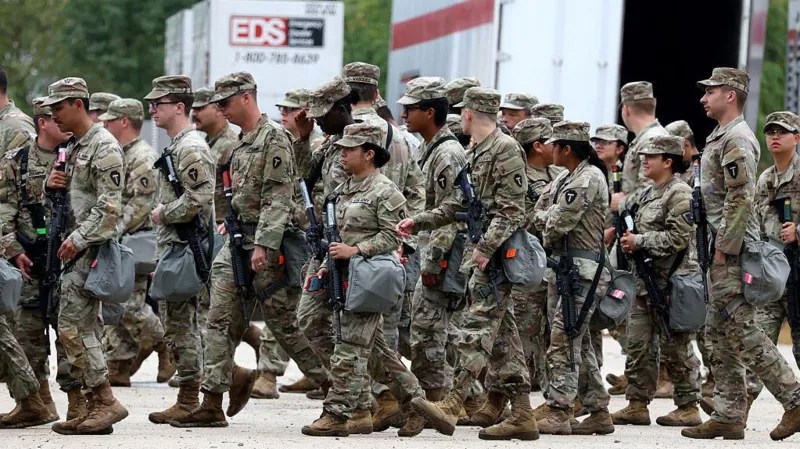
National security is now said to require widespread domestic repression: “We have to handle it before it gets out of control,” said Trump. He confirmed the shift to internal order when he announced that the National Guard would be sent to Chicago in October 2025: “We should use some of these dangerous cities as training grounds” for military forces. Immigration and Customs Enforcement (ICE), and National Guard staging areas are being set up in major US cities governed mainly by Democratic Party leaders. These areas function like US military bases abroad—launching pads for attacks, but this time on domestic “enemies.” City and state leaders are vigorously protesting these incursions, but to no avail.
“National security” has again become the catchword to justify all manner of official acts that have little or no bearing on the nation’s security. Every tariff increase—on furniture, foreign movies, aluminum, coffee, wine—is a national security measure. Border reinforcement against increasingly few illegal migrants is to bolster national security. Dispatching regular military units to cities is justified on national security grounds. Pressuring law firms, universities, and social media companies to conform with the administration’s policy on Diversity-Equity-Inclusion, and pay huge fees for compliance, is necessary for national security.
The Trump administration has learned from authoritarian regimes, as well as from previous administrations, that cloaking official acts in the language of national security is almost certain to overcome local protests and secure Supreme Court approval. Deference to presidential authority in foreign affairs, particularly in wartime, has a long history that is now being tested in domestic affairs, and on the same basis: the President’s claim to exercise supreme power in identifying and acting on national security threats. The Court’s deference to Trump has already been demonstrated by its approval of freezes on foreign aid and termination of aid workers despite appropriations by Congress. It will soon act on Trump’s tariffs, deportations, and National Guard deployments, in many cases overriding the wishes of state governors and legislatures. But Trump is also saying he doesn’t need court approval. He has threatened to invoke the 1807 Insurrection Act, which empowers the president to deploy the US military domestically and to federalize National Guard troops in cases of “unlawful obstructions, combinations, or assemblages, or rebellion against the authority of the United States.” Trump considered invoking the law in his first term but was persuaded against doing so. Now the White House is claiming that the law can be used to protect federal officers and assets, and to deal with “the lawlessness plaguing American cities” (https://www.nbcnews.com/politics/trump-administration/insurrection-act-what-know-national-guard-deployment-protests-courts-rcna236162). (In fact, major crime rates are down in every city to which Trump has dispatched troops.) The Insurrection Act has not been used since the Los Angeles riots in 1992, following the acquittal of police officers who had been filmed brutally beating Rodney King. Back then, President George H.W. Bush acted at the request of the city’s Democratic mayor and the state’s Republican governor. Trump is inclined to ignore the need for requests to act; he sees the Act as a way to bypass the courts. “If I had to enact it,” Trump says, “I’d do that if people were being killed and courts were holding us up, or governors or mayors were holding us up.” That is a troubling boast: that judicial decisions will be ignored if they are “holding us up.”
Foreign Policy Comes Home
Trump has largely turned his attention away from foreign policy in his second term. Aside from arbitrary tariffs, he has mainly sought the Nobel Peace Prize by concocting false claims of ending wars and promoting peace plans that offer no relief for the Ukrainian and Palestinian victims and give a pass to leaders in Moscow and Tel Aviv who have been judged criminals by international courts. In Asia, Trump been unable to bring China to heel; his tariff and foreign aid policies have alienated key US allies (Japan and South Korea), bewildered the heads of US multinational corporations, and been gifts to Beijing, whose trade and aid terms look more attractive than Trump’s in East and Southeast Asia, Africa, and Latin America. The pendulum has swung: Foreign policy is now domestic policy. The assaults on cities, the militarization of the southern border, the attacks (four so far) on presumed drug smugglers at sea, the targeting of liberal groups as supporters of “domestic terrorism”[i]—these all must be met with force (https://www.reuters.com/legal/government/trumps-war-left-inside-plan-investigate-liberal-groups-2025-10-09/). The cities are “war zones” (Kristi Noem, Secretary of Homeland Security, referring to Chicago), the border wall is necessary to stop an “invasion” (Trump), illegal immigrants are terrorists, groups like the Soros Foundation, ActBlue, and Indivisible are fueling left-wing violence, and the drug smugglers are (in Trump’s words) “unlawful combatants” engaged in “armed conflict” with the US (https://www.nytimes.com/2025/10/02/us/politics/trump-drug-cartels-war.html). These are the language and actions of a government at war, yet in all these cases it is the government that is inflicting casualties against a defenseless citizenry with blatant disregard for evidence.
Conducting national security under “wartime conditions” has allowed Trump to carry out a major expansion of presidential power, just as the Project 2025 paper had proposed in the idea of a unitary presidency. That idea has been effectively insinuated into every level of federal authority. Examples include the government’s freezing or withholding of funds appropriated by Congress; Trump’s failure to consult with Congress on major foreign policy matters (such as the attack on Iran’s nuclear facilities in June 2025, and a defense commitment to Qatar in October); the President’s firing of officials in once-independent agencies; his open defiance of court orders on deportations; the remaking of the justice department into the personal arm of the President in pursuit of his critics and liberal organizations; the Department of Government Efficiency (DOGE)’s seizure and sequestering of private data in Social Security and other government programs; the evisceration of environmental protection legislation and erasure of once-public information on the environment; the overturning of traditional alliance relationships and memberships in several international organizations (from NATO and the Paris Accords on global warming to UNESCO and the United Nations Human Rights Council); and the extraordinary array of corrupt practices by the President and senior officials in clear violation of conflict-of-interest and other regulations (e.g., Trump’s cryptocurrency schemes, Jared Kushner’s and Steve Witkoff’s business dealings in the Middle East, and a $50,000 cash payoff to border czar Tom Homan for help in obtaining government contracts). Congress has lost all independence of action under Republican control, the Democratic Party is powerless to influence Trump’s policies, and the Supreme Court has a majority of justices who favor presidential immunity and power with few limitations.
“Trump’s Invasion”
Illinois Governor JB Pritzker used those words in calling out Trump in October 2025 over the President’s abuse of power in sending troops into Chicago. Fortunately, some judges are willing to stick their necks out on behalf of embattled citizens. One of them is US District Judge Karin J. Immergut, a Trump appointee who angered him with an extraordinary defense of popular resistance when she issued a temporary restraining order against the administration’s dispatch of 200 National Guard troops to Portland, Oregon. Judge Immergut wrote: “This country has a long-standing and foundational tradition of resistance to government overreach, especially in the form of military intrusion into civil affairs. This historical tradition boils down to a simple proposition: this is a nation of constitutional law, not martial law.” She dismissed Trump’s wild claims of violence and rioting in Portland, saying these were “simply untethered to the facts.”
Oregon’s attorney general said the ruling halts “what appears to be the president’s attempt to normalize the United States military in our cities.” But it may only temporarily halt Trump’s flouting of the law and ignoring of facts on the ground. He ordered 300 National Guard soldiers from California to Portland—“a breathtaking abuse of the law and power,” said Governor Gavin Newsom—and ordered 200 troops from the Texas National Guard to Chicago, to join 300 from the Illinois National Guard. On October 9, 2025, Judge April M. Perry issued a temporary restraining order that blocks the deployment of National Guard troops in Illinois for fourteen days. Judge Perry ruled that the Trump administration had failed to provide credible evidence of a “rebellion” that would legally justify the deployment. (An appeals court directed that the Guard could stay in the state but could not protect property or patrol.) Judge Immergut extended her ruling to include any soldiers from any state being relocated to Oregon. But an appeals court overruled Immergut on October 20. All these court cases will probably wind up in the Supreme Court.
Neither Portland nor Chicago is a hotbed of lawlessness and large-scale civil disturbances such as might justify armed federal intervention. Trump’s absurd depiction of Portland, for example, as being “on fire for years” and a “really criminal insurrection” reflects his determination to use the military no matter the circumstances. Until his troop order, federal officials had characterized Portland demonstrations as “low energy.” They only got more intense after Trump posted on his social media that the “War ravaged” city was “under siege from attack by Antifa” (https://www.nytimes.com/2025/10/08/us/politics/trump-portland-troops.html).
The legal battle elsewhere is also very much up in the air. The 4,000 troops deployed to Los Angeles and the 2,000 National Guardsmen and regular military troops in Washington, DC remain issues before the courts. Charles R. Breyer, a US district judge in California, ruled that the administration’s action in Los Angeles “willfully” violated the 1878 Posse Comitatus Act, which restricts the use of federal military forces for domestic law enforcement. But an appeals court ruled that troops “could engage in certain law enforcement activities,” such as to protect government buildings. The Los Angeles case is still on appeal, leaving the deployments in place, though in reduced numbers. In short, all lower court judges have issued scathing rebuffs to Trump’s orders, in essence saying the arguments for them in court were completely without merit and bordered on lies. Trump and Steven Miller have insisted the judges were subverting presidential authority (https://www.washingtonpost.com/opinions/2025/10/15/judges-trump-rebel-military-insurrection/).
False Flag
Integrating National Guard and border control forces with local police is “unnecessary and counterproductive,” one senior Portland police official declared in court. Unnecessary, because the protests at the ICE facility were tiny and (as the judge said) “uneventful.” Counterproductive, because the Guard’s presence would probably heighten tensions, increase the potential for violence, and make law enforcement more difficult. (https://www.washingtonpost.com/politics/2025/10/04/trump-portland-oregon-national-guard/). Far from being concerned about the prospect of violence, Trump seemed to welcome it. “His troop deployments are a false flag—meant to provoke a response in order to justify harsh crackdowns,” said Miles Taylor, who served as deputy chief of staff in Homeland Security during Trump’s first term (Former Trump official ‘Anonymous’ warns troops in cities are ‘false flag’).
It’s the politics of incitement, injected with Trump’s militant rhetoric. He has endorsed the use of “full force” in multiple cities and threatened to arrest Chicago’s mayor and the Illinois governor. In Chicago, ICE agents used tear gas to disperse protesters, rappelled by helicopter onto an apartment building where they zip-tied children as well as adults, and broke into apartments in search of alleged Venezuelan gang members. ICE has become a branch of Trump’s regular army, with a huge budget, advanced armaments, and a mission to match. Or consider Trump’s threat to dispatch the 82d Airborne, an elite force that undertakes special missions abroad, to Portland. Trump appointees follow suit. Steven Miller, the White House deputy chief of staff, claimed on CNN that Trump has “plenary authority” over military deployments—the right to use them as he pleases. (He stopped short in the interview when, apparently, he realized he had overstretched.) Kristi Noem, Homeland Security secretary, told a right-wing podcaster that ICE would be “all over” the next Super Bowl. One of her advisers, Corey Lewandowski, followed up with this remark: “There is nowhere that you can provide safe haven to people who are in this country illegally. Not the Super Bowl and nowhere else. We will find you,” he went on, and “we will put you in a detention facility, and we will deport you” (https://www.nytimes.com/athletic/6684352/2025/10/02/ice-super-bowl-bad-bunny-corey-lewandowski/)
Trump clearly endorses such threats and uses them to partisan advantage in his role as commander-in-chief, as in speeches he has made to military leaders, soldiers, and sailors. On those occasions, Trump has not only shared his personal grievances but also tried to reinforce his authority over the military, much as defense secretary Pete Hegseth has done with his purge of dozens of senior officers who don’t measure up to the new (politicized) definition of loyalty. Trump assured sailors aboard an aircraft carrier in Norfolk, Virginia that “no one cares” that he had sent troops into cities. Speaking before US troops at a naval base in Japan on October 28, Trump said “we can’t have cities that are troubled,” and “if we need more than the National Guard, we’ll send more than the National Guard . . . ” This threat may be connected with the US gunboat diplomacy in the Caribbean: The attacks, which constitute “extrajudicial killings” (Senator Rand Paul), may be meant as a warning to Americans that this administration will not tolerate activist dissent.
Limited Options
Many senior military officers, including General Dan Caine, chairman of the joint chiefs of staff, are reported to be upset over Trump’s repeated use of the military, including ICE, against Americans. Some officers must surely also be angered over the legally questionable attacks on Venezuelan boats, including Adm. Alvin Holsey, head of the US Southern Command, who apparently resigned in protest. These officers understand that the US armed forces and National Guard should never be deployed to satisfy a president’s personal political agenda. Trump’s conduct clearly violates the Constitution and suborns democracy and the rule of law. Surely some of our military leaders are keenly aware of what the militaries in other countries have done when faced with abuses of national security by corrupt, incompetent, and self-interested politicians. But even if they privately acknowledge that it is Trump who tried to carry out a coup on January 6, 2021 and, having failed then, may be preparing to stage another one today, the professional military gives no indication that it is prepared to defy the commander-in-chief.
Political and military leaders who want to rely on legal redress and peaceful protests of Trump’s abuses of power face formidable obstacles. While lawsuits to stop Trump’s troop deployments may delay them, six Supreme Court justices are fully behind him. Trump can also count on red-state governors to send their National Guard units to blue states at his behest, further escalating tensions. Local laws, such as California’s ruling that ICE agents must remove their masks, and Chicago’s establishment of “ICE-free zones” on city property to ban staging areas without a warrant, cannot keep pace with large-scale deployments of soldiers and weapons in many states. At some point troops and crowds are bound to collide. ICE agents have already fired weapons and tear gas at people in several incidents in Chicago and Portland. It may be only a matter of time before some people fire back, giving troop commanders and Trump the excuse they need to invoke the Insurrection Act.
Mass nonviolent resistance, from protests and short-term economic boycott to a general strike; concerted action by local leaders to constrain troop and ICE deployments; and persistence in lawsuits[2] would seem to be the best hope of undercutting Trump’s war on America. Resignations of government officials who are dedicated to the rule of law are also helpful; they are on the rise, according to Citizens for Responsibility and Ethics in Government (CREW). Nor should we diminish the importance of the 2026 and 2028 elections, despite pro-Trump gerrymandering and other tricks: Recent history shows that defeating authoritarianism at the ballot box is possible even under very trying circumstances (https://www.nytimes.com/2025/10/02/opinion/poland-election-autocrat-russia-hungary.html). If these efforts fail, Trump’s rule may lead to martial law imposed on our cities and to the mass detention of his critics—all in the name of national security.
Note to readers: This essay is an extended version of Post #477, published on October 1. Thanks to Mark Selden for helpful comments.
[1] According to Just Security’s litigation tracker (https://www.justsecurity.org/107087/tracker-litigation-legal-challenges-trump-administration/), the Trump administration won only seven of 465 cases brought against the administration, 142 have resulted in court-ordered blocks of one kind or another, and court rulings are awaited in 218 cases (as of October 17, 2025).
[2] See the excellent article on Trump’s targeting of left-liberal individuals and groups by Nandita Bose, Jana Winter, Jeff Mason, Tim Reid and Ted Hesson, “Trump’s War on the Left,” https://www.reuters.com/legal/government/trumps-war-left-inside-plan-investigate-liberal-groups-2025-10-09/.
 In the Human Interest - Mel Gurtov
Mel,
Magnificent Post, #482. Here is a comment that I tried to post on your site, but I didn’t get through FB and WP sign-in procedures. So I’m sending it directly to you.
Referring to your prescient statement,
“But even if they privately acknowledge that it is Trump who tried to carry out a coup on January 6, 2021 and, having failed then, may be preparing to stage another one today, the professional military gives no indication that it is prepared to defy the commander-in-chief.”
I am afraid that this is the best prediction I have seen of what’s to come. Based on that, I am beginning to urge everyone I can in political life as well as public to begin anticipating the form that coup could take — and to prepare counter-moves against each form we can imagine.
One thing to note about the January 6, 2020, coup attempt was the sophistication of their strategy. In the Vietnam anti-war movement and associated radical or even revolutionary political movements in the 1960s, we never thought that boldly or dreamed of staging events that were potentially that effective. The ability to frame such a radical and effective action, whether it succeeded or not, was in itself a stroke of genius.
So everyone who loves our country must now get smarter than we were in those days, and start anticipating the genius-quality moves the Trump team could make.
I include among the “everyone” in that paragraph the generals and admirals who have traditionally been devoted to upholding our constitution from the days they were cadets at West Point and the Naval Academy. We are all bedfellows, and we’re all in this together.
~ Jim
James R. Newcomer, Ph.D. Developmental and Line Editing NewcomerEdits.com jim@NewcomerEdits.com (503) 351-9330
No coup is possible when the general population is not apathetic — but—the rest is history.
I get a thrill out of hearing former supporters of the administration saying such things as “I never voted for this.” when, in fact, they knew damned well what they were voting for because Mr. Trump has always been very vocal about his intentions and he is following through and people ought to get used to that and take a little responsibility themselves because voting does have consequences. Besides which, I do not see a problem because i am getting along fine as are millions of other Americans. Nobody really knows what the future will bring however.
As you say, John , we all knew what Trump had in mind for us..Project 2025 was available to everyone. I’m getting along just fine, too, but I cry for the country. We can’t know the future, but we shouldn’t hide behind that truism. We know quite enough already. Thanks for writing.
Gee, Mel, it is thrilling to see your comment and I do so sincerely appreciate it ..thank you….No, we cannot see the future….but since the country is almost wrecked now…the future almost has got to be very challenging in my opinion. Again, thank you for commenting….You are always welcome here even if we should disagree on some things… you are always welcome.
Great comment, Mel…thank you….