
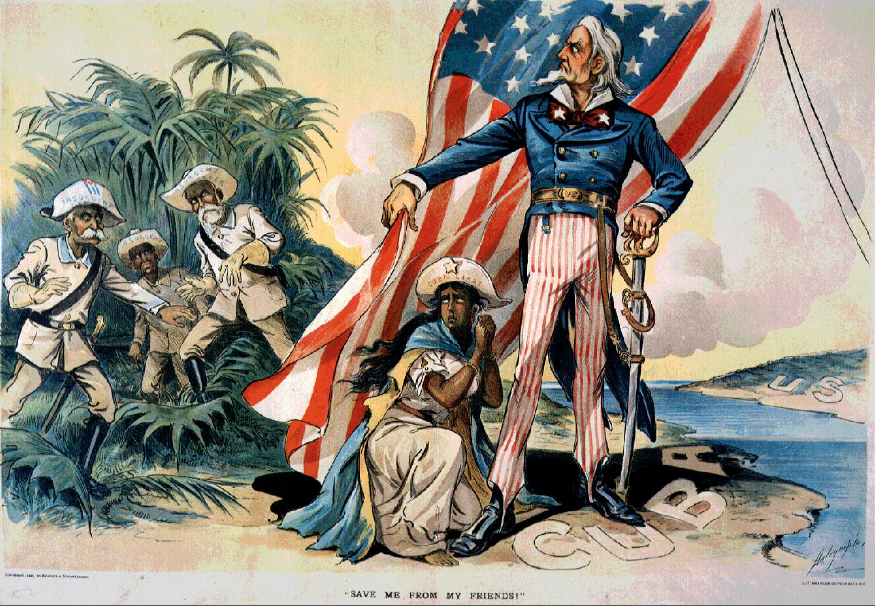
Another Nonexistent Threat
Regime change in Cuba may be the next stop for the Trump war machine. Here’s what he told CNN in an interview March 6: “Cuba is gonna fall pretty soon . . . They want to make a deal, and so I’m going to put Marco ]Rubio] over there and we’ll see how that works out. We’re really focused on this one [Iran] right now. We’ve got plenty of time, but Cuba’s ready — after 50 years . . . I’ve been watching it for 50 years, and it’s fallen right into my lap because of me, it’s fallen, but it’s nevertheless fallen right into the lap. And we’re doing very well.” The justice department followed up by indicting several Cuban officials and entities for their alleged involvement in drug trafficking—a tactic now also being used to pursue another Trump critic, Colombia’s President Gustavo Petro.
The authority for Trump’s threats to Cuba are contained in an executive order on January 29, 2026. It states that “the policies, practices, and actions of the Government of Cuba constitute an unusual and extraordinary threat” to U.S. national security and foreign policy. The executive order E.O. declared a national emergency under the National Emergencies Act and invoked the International Emergency Economic Powers Act of 1977, which empowers Trump to impose tariffs on foreign countries that “directly or indirectly” supply oil to the Cuban government (https://www.congress.gov/crs-product/IN12650).
To be clear, Cuba presents no national emergency, nor is there evidence that Cuba constitutes a threat of any kind to US national security—no more so than Iran or Venezuela. The real emergency in Cuba is humanitarian: the needless suffering inflicted on the Cuban people by the US energy blockade, which is preventing necessities such as food, medicine, and medical equipment from reaching them.
Naked Imperialism
In a January 11, 2026, social media post, shortly after US forces seized Venezuela’s leader, Nicolas Maduro, Trump asserted that there would be “NO MORE OIL OR MONEY GOING TO CUBA.” Trump is in the driver’s seat on Cuba: The threat to its oil suppliers of high tariffs, accompanied by a cut-off of Venezuelan oil shipments to Cuba, has left Cuba’s economy without imported oil for 3 months. Cuba relies on those shipments for around 60 percent of its energy. Cuba’s president, Miguel Diaz-Canel, has little choice but to deal with Trump; he’s now in talks with the US. Diaz-Canel says he is insisting that the talks must take place with mutual respect for each other’s political systems, which is about the last thing Trump would agree to. He and Rubio want nothing less than a dismantling of Cuba’s political-economic system. Diaz-Canel seems willing to make economic changes, such as allowing exiles to invest in the island. His government has also released some political prisoners.
Rubio quickly made clear that Diaz-Canel’s proposals were insufficient. “Cuba has an economy that doesn’t work and a political and governmental system that can’t fix it,” Rubio said. “So they have to change dramatically. What they announced … is not dramatic enough. It’s not going to fix it. So they’ve got some big decisions to make over there.” What Rubio is really saying is that nothing short of regime change will satisfy the US. Trump has said just that; a week ago he demanded the resignation of Diaz-Canel. Bloomberg reports that “People familiar with the matter say Trump . . . wants to use American economic pressure to make the island nation financially dependent on Washington. The US would essentially take the place of its onetime rival, the Soviet Union.” Presumably, Trump will decide who should be president of Cuba. Marco Rubio would then become Cuba’s viceroy, dictating policies designed to keep Cuba firmly under US control.
On March 18 Trump told reporters: “we’ll be doing something with Cuba very soon.” A day earlier, the president floated the idea of “taking Cuba in some form,” after saying last month a “friendly takeover of Cuba” was possible. “Whether I free it, take it, I think I could do anything I want with it,” he told reporters. Spoken like a true imperialist.
Resistance is Promised
US threats have led Diaz-Canel to say Cuba will resist any US attempt to take over the island. “In the face of the worst scenario, Cuba is accompanied by a certainty: any external aggressor will clash with an impregnable resistance,” Diaz-Canel said. But when it comes to the capacity to resist, Cuba is far more like Venezuela than like Iran. Gone are the days when Cubans rose up against an invasion. That was in 1961, when the new Kennedy administration suffered its first major foreign policy defeat. He expected Cubans to reject Fidel Castro’s revolution and welcome the overthrow of the government by Cuban exiles who had trained in Guatemala with the full knowledge of the preceding Eisenhower administration. Didn’t happen; the exiles’ invasion was easily defeated. Fidel welcomed the Russians instead, and a year later the US-Russia missile crisis resulted. Diaz-Canel isn’t Castro, and it is hard to see how a US show of force could be effectively resisted when the country is on the verge of economic collapse. And this time around, Trump has plenty of support in Congress for overthrowing Cuba’s legitimate rulers. Only the war with Iran, he says, affects the timeline for dealing with Cuba. Should Trump fail to achieve any of his objectives in Iran, as now seems likely, he may be more determined than ever to seek a “win” in Cuba.
 In the Human Interest - Mel Gurtov