
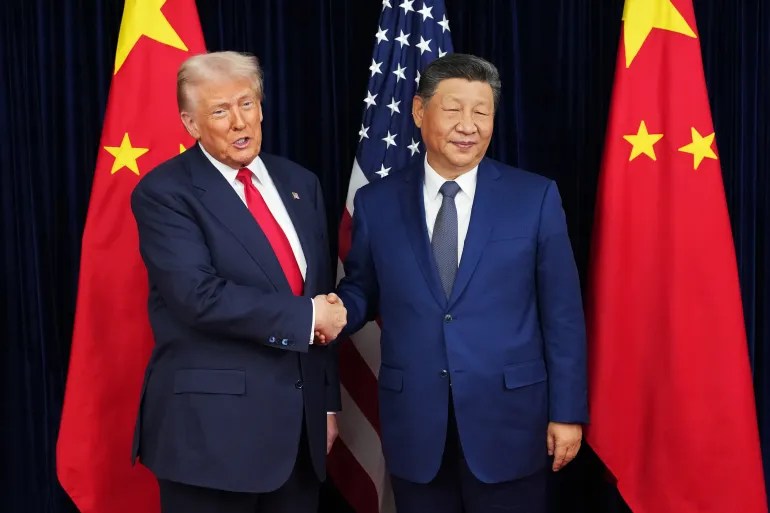
The Trump administration’s National Security Strategy paper released this month is filled with nasty, nativist language and half-truths straight out of the Project 2025 playbook. But amidst the bluster about historic success in strengthening national security and claims about resolving wars is a stark reminder of the direction US foreign policy is taking, which looks to be a world divided into American, Chinese, and Russian spheres of influence. That would explain why Latin America receives so much more attention in the NSS paper than China or Russia. The theme of strategic competition with those two countries that was emphasized in Trump’s first national security overview has vanished. Now, China is viewed mainly as an economic rival. That is surely welcome news in Beijing.
Competing with China
The NSS paper, like Project 2025, decries previous Democratic efforts to bring China into a “rules-based” international system. The NSS offers an alternative that really isn’t: to “rebalance America’s economic relationship with China, prioritizing reciprocity and fairness to restore American economic independence.” In other words, seek what previous administrations have sought with China: get it to abide by rules of fair competition. The paper offers complaints we’ve heard before: China’s “unfair trade policies” such as state subsidies, intellectual property theft, industrial espionage, and “threats against our supply chains that risk U.S. access to critical resources, including minerals and rare earth elements.” To counter China, the NSS says the administration will work with partners such as India (no reference to US tariffs that have undermined that relationship), protect critical infrastructure, invest in “research to preserve and advance our advantage in cutting-edge military and dual-use technology . . . ,” and urge Europe and Asian partners to adopt “trade policies that help rebalance China’s economy toward household consumption . . . ” Nothing new there.
Despite those statements, the Trump administration has removed export restrictions on one of Nvidia’s most advanced AI computer chips, the H200, apparently in anticipation of a “big deal” on trade. Those are not the most powerful Nvidia chips, but they might have military as well as commercial value. Yet, in announcing the deal, which includes giving the US government twenty-five percent of sales, Trump assured one and all that the deal will be “under conditions that allow for continued strong National Security.” Evidently, not strong enough: The announcement coincided with another one from the US attorney for the southern district of Texas: interception of $160 million worth of Nvidia H100s and H200s that were destined, he said, for China and other countries. Further undercutting the Nvidia sale is China’s reported decision to turn down the H200, preferring to use semiconductor chips it has developed on its own. Jensen Huang, the CEO of Nvidia who would be the chief beneficiary of the deal, blamed the last two US administrations for this unexpected Chinese decision. “It’s clear that three years of overbroad export controls fueled America’s foreign competitors and cost US taxpayers billions of dollars,” Nvidia said. In other words, Trump, like Biden, hasn’t paid attention to the Chinese push for greater self-reliance in advanced technologies.
Deterrence By Other Means
Economic competition, the NSS says, “must be accompanied by a robust and ongoing focus on deterrence to prevent war in the Indo-Pacific” and “preventing domination [in Asia] by any single competitor nation.” Achieving those goals is largely left to Japan, South Korea, Australia, and other partners: “America’s diplomatic efforts should focus on pressing our First Island Chain allies and partners to allow the U.S. military greater access to their ports and other facilities, to spend more on their own defense, and most importantly to invest in capabilities aimed at deterring aggression.” What is new here is not the goals but the means to achieve them as the US shifts naval power away from Asia and into Latin America.
What does that shift mean for the two main arenas of tension with China: Taiwan and the South China Sea? Trump has wavered on US policy on Taiwan. Sometimes he has aligned with traditional strategic ambiguity over what the US might do if China sought to absorb Taiwan. And just the other day the administration proposed a $10 billion arms sale to Taiwan, larger than any under Biden. At other times, however, Trump has said that Taiwan wasn’t doing enough in its own defense while raking in money from its dominance in the semiconductor trade. The NSS paper recognizes Taiwan’s economic value to the US; hence “deterring a conflict over Taiwan, ideally by preserving military overmatch, is a priority. We will also maintain our longstanding declaratory policy on Taiwan, meaning that the United States does not support any unilateral change to the status quo in the Taiwan Strait.” But that’s not what Trump said as recently as a week ago when Xi Jinping thanked him for supporting “one China,” or what Trump did when he restrained Japan’s prime minister from repeating her unprecedented pledge to counter a Chinese attack on Taiwan. The Taiwan leadership is pressing for a major increase in military spending, both to satisfy Trump and to hedge against uncertainty about US support.
As for the South China Sea, its value to the US is also cast in economic terms: the sea lanes that run through it. Thus: “Strong measures must be developed along with the deterrence necessary to keep those lanes open, free of ‘tolls,’ and not subject to arbitrary closure by one country. This will require not just further investment in our military—especially naval—capabilities, but also strong cooperation with every nation that stands to suffer, from India to Japan and beyond, if this problem is not addressed.” Nothing new here.
So What’s New?
Two things strike me about the China section of this NSS. One, as mentioned, is that it is more consistent with the China policy of recent Democratic administrations than it cares to admit with respect to trade and deterrence. Where Trump has diverged from past policies is a willingness to engage in a tariff war with China (which he has clearly lost) and a lower valuation of traditional allies such as Japan and South Korea. Even personal diplomacy with China, favored by Trump’s predecessors, is back in vogue at Trump anticipates a visit to China in April 2026.
The second point has to do with strategic papers in general. All administrations issue them, but whether or not they are followed is another matter. The previous Trump NSS gave no hint of Trump’s leanings toward Russia or his strongly negative views of the EU and NATO. The current NSS is surely accurate about the administration’s absorption with commercial factors: tariffs, investments, technology, defense spending. But as a guide to policy of the moment, especially concerning China, the strategy paper must be considered of limited value. We have a president who is capable of 180-degree policy turns at any moment. If Trump gets his big trade deal with China, he’ll abide by the main guidelines in the NSS. But if not, expect a return to Cold War-style competition and tariff hikes.
 In the Human Interest - Mel Gurtov