
A “Come-to-Jesus” Moment
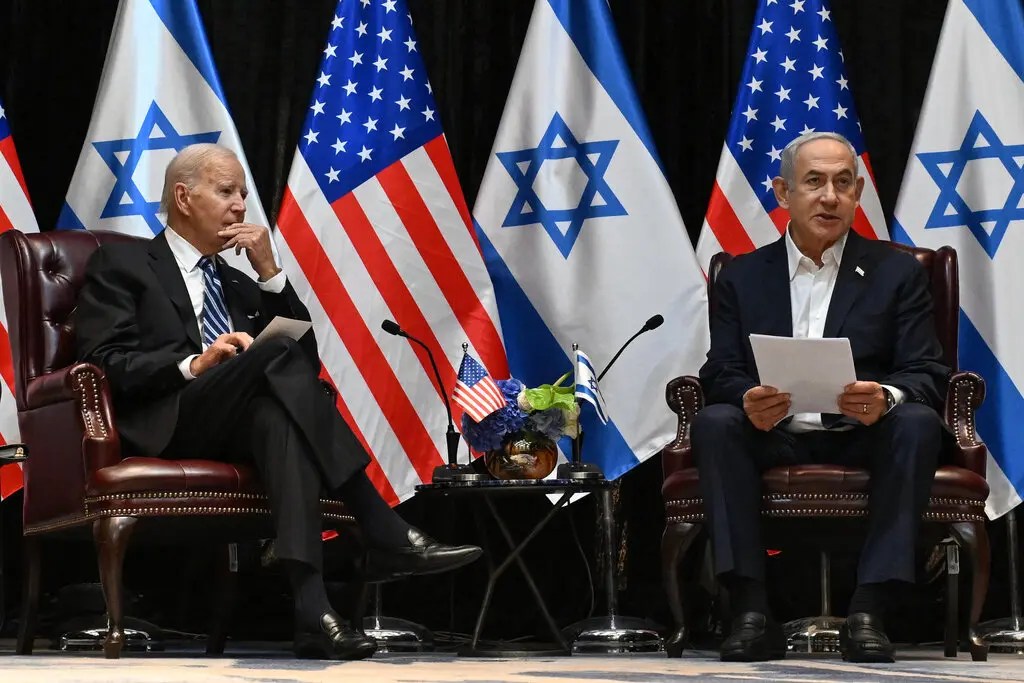
Following the State of the Union speech, President Biden had a conversation on the House floor with Senator Michael Bennet, Democrat of Colorado, who urged the President to “keep pushing Netanyahu.” “I told him, Bibi,” said the President, using Netanyahu’s nickname, “and don’t repeat this — but, ‘You and I are going to have a come-to-Jesus meeting.’” His comment was caught on a microphone. Told he had been overheard, Biden was unperturbed. “I’m on a hot mic here,” Biden told Bennet. “Good. That’s good.”
A come-to-Jesus meeting with Netanyahu cannot come soon enough. Because the President is in a policy bind: how to stay faithful to support of Israel’s self-defense while also helping stop the humanitarian catastrophe taking place in Gaza, with US-made bombs dropping on civilian targets. It’s a classic lose-lose scenario that is costing the President dearly in political support at home and abroad. So long as this contradiction in policy on the war—bombs and bread—continues, Biden’s Middle East strategy cannot succeed. It will prevent implementation of a plan for new leadership in the Palestinians’ West Bank leadership and for the ultimate goal of a Palestinian state side by side with Israel. Current policy will also enable Hamas to keep recruiting, Hezbollah to keep attacking from Lebanon, Iran to keep supporting the Houthis and other militias, Saudi Arabia and other Arab states to reject normalizing relations with Israel, and Russia and China to make gains in the Middle East. That’s a very long laundry list of negative consequences, the sort that could eventuate in a regional war in which the US would almost certainly have to become directly involved.
Time to Play Tough
It is being reported that the terrible incident that occurred recently in Gaza in which over 100 people were killed and many more injured when an aid convoy was besieged by Palestinians desperate for relief, with many of them shot by Israeli soldiers, was a tipping point in Biden’s approach to humanitarian aid. The incident spawned Biden’s plans to airdrop aid packages and build an offshore facility to bring in more aid. Such plans, however well-intentioned, are a diversion from the policy challenge Biden must face head-on: demanding of Netanyahu that his government either dramatically improve the humanitarian situation in Gaza by removing obstacles to aid deliveries or face suspension of non-defensive military aid.
That would be a come-to-Jesus moment for both parties. The message for Netanyahu would be that his resistance and stalling on US concerns will no longer be tolerated. Aid has a price, even among allies, and especially military aid that not only is enabling Israel’s war-without-end but also enabling Bibi’s continuation in office. Biden’s consistent entreaties to Bibi must turn into serious pressure, of a kind that will get Netanyahu’s attention. Netanyahu, like all his predecessors, thinks no US president would wish to be seen abandoning Israel or treating it as anything but a valuable ally. He needs to be disabused of such thinking.
Responding to the “Heartbreaking” Situation
Yes, Biden will have to pay a political price for using pressure tactics, not least giving Donald Trump ammunition to pose as Israel’s real friend, with a pat on the back from Netanyahu. But Biden is a savvy politician who understands full well Netanyahu’s game: in a word, be in no hurry to end the war. Biden needs to be in a hurry for the sake of his own, and US, interests. He must be true to what he has been saying for some time, and repeated in his State of the Union address: The humanitarian situation in Gaza is “heartbreaking.” To quote him:
“This war has taken a greater toll on innocent civilians than all previous wars in Gaza combined. More than 30,000 Palestinians have been killed, most of whom are not Hamas. Thousands and thousands of innocents, women and children. Girls and boys also orphaned. Nearly two million more Palestinians under bombardment or displacement. Homes destroyed, neighborhoods in rubble, cities in ruin. Families without food, water, medicine. It’s heartbreaking.”
It is indeed heartbreaking, but the US needs to do much more than shed tears and implore an Israeli leadership that is untroubled by the horrific civilian casualties. The Biden administration needs to face up to the glaring contradiction in its war policy, call for an indefinite cease-fire, the release of all hostages, and—as I have argued here—resolution of the contradiction by tying further non-defensive military aid to ending the humanitarian crisis. He has the power of law behind him: National Security Memorandum 20 and the Humanitarian Aid Corridor Act, both of which empower the President to sanction governments that use US arms to abuse human rights.
Please subscribe to my podcast. It’s free at https://melgurtov.substack.com

 In the Human Interest - Mel Gurtov